AI Industry
Arda Raises $232M at $1.5B for Factory AI
Oct 21, 2026·5 min read·By Rahish Saifi
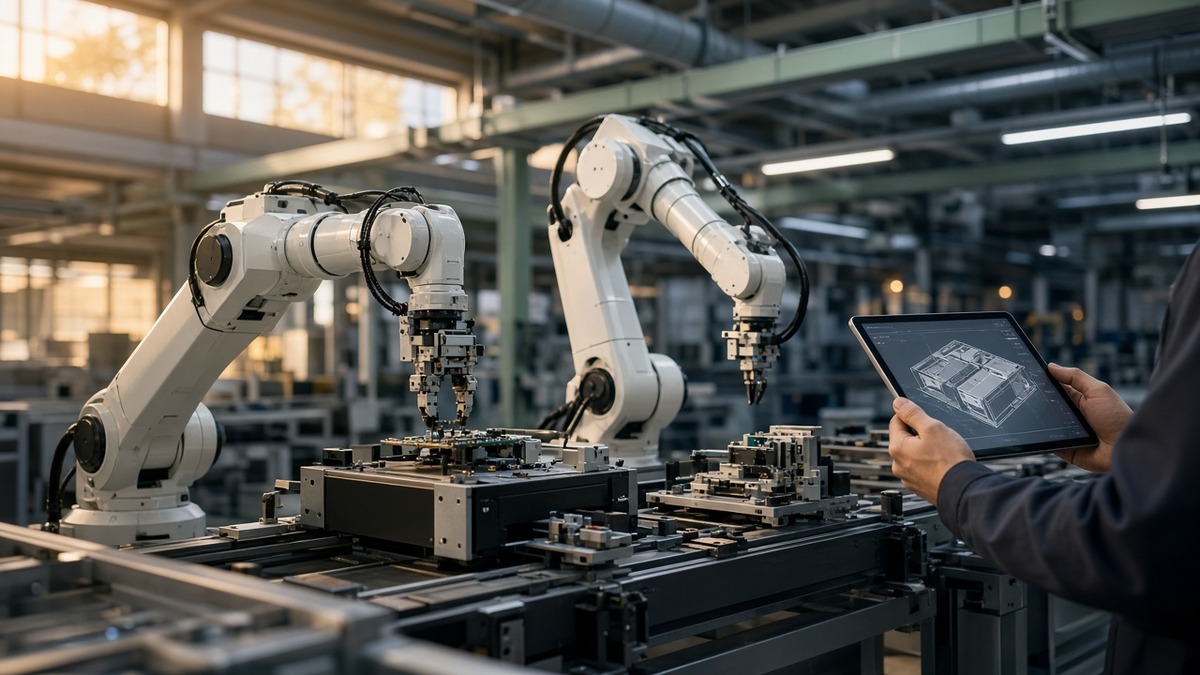
Arda Industries on October 20, 2026 launched from stealth with $232 million in total funding to build AI software that turns product designs into adaptable factory assembly lines. In a SiliconANGLE report, the San Francisco company said the capital backs a platform that plans stations, robots, quality checks, and visual work instructions from CAD files and other design artifacts—and keeps production current as those designs change. CNBC put the total raise at $230 million; BusinessWire’s figure is $232 million, which this article uses unless noted.
Key facts
| Item | Detail |
|---|---|
| Total funding (announced) | $232M (BusinessWire) |
| Series A | $160M at $1.5B valuation; co-led by Altimeter, Accel, and Khosla Ventures; XYZ Venture Capital, 8VC, SVAngel, Felicis |
| Seed | $72M led by Accel and Founders Fund; Khosla Ventures and XYZ Venture Capital also participated |
| CEO | Bob McGrew — former OpenAI Chief Research Officer (left Sept. 2024); ex-Palantir product and engineering leader |
| Live customer | Anduril Industries — Arda deployed inside ArsenalOS; collaboration began before Arda incorporated |
| Focus markets | Defense and data-center supply chain (transformers, electrical gear); consumer electronics (phones, drones) next |
| Company site / media | arda.ai |
The raise at a glance
Arda’s $160 million Series A at a $1.5 billion valuation follows a $72 million seed, bringing disclosed funding to $232 million. Accel, which led the seed alongside Founders Fund, co-led the Series A with Altimeter and Khosla Ventures, with XYZ Venture Capital, 8VC, SVAngel, and Felicis joining the A round, per BusinessWire and Accel’s investment note.
What Arda builds
Arda describes its product as an AI agent for manufacturing engineers. It ingests a product’s CAD and related design files, then outputs an assembly plan: which stations handle which steps, how robots and people should be arranged, how quality should be monitored, and what visual work instructions operators need on the line.
When the design revs, the software refreshes those plans so changes reach the factory without stopping production. BusinessWire compares the problem to assembling a 7,500-piece Lego set with no instruction booklet—someone must derive order of operations and station layout every time the SKU changes.
McGrew told CNBC the company is building a user interface and agent that does for manufacturing engineers what tools like Claude or Cursor do for programmers—natural-language and agentic workflows on top of deep technical artifacts. That framing matters for readers tracking how frontier LLM teams are productizing “copilot” patterns outside software development.
Why factories lag design
Hardware now iterates at something closer to software cadence. BusinessWire notes that mobile phones ship a new generation about every year, with only roughly a quarter of parts carrying over. Defense platforms change as threats evolve; drones, robots, and data-center gear are redesigned constantly.
Automation has not kept pace. Programming a conventional automated station can take three to six months and cost close to $1 million, while a new phone might run at full-rate production for only about four months—so by the time a robotic line is ready, the product has moved on. In Asia, large teams of manufacturing engineers retool phone lines each generation; in the U.S., fast-changing hardware gets built only where the price can carry the labor and engineering cost, as in defense—and at consumer scale it mostly isn’t built here at all.
Manufacturing engineers are also scarce domestically; Arda argues its software multiplies senior engineers’ output so plants can absorb more design churn without proportional hiring.
Anduril deployment
Anduril Industries is already using Arda as part of ArsenalOS, Anduril’s manufacturing software stack. The companies began working together before Arda was incorporated; Anduril was Arda’s first design partner and customer, according to BusinessWire.
Anduril and Arda cite dramatic time savings on documentation and planning workflows—figures attributed to the companies and Anduril’s experience, not independent benchmarks. BusinessWire says basic work instructions that once took 10 hours can be created in 15 minutes, while more complex engineering workflows that previously took up to 30 hours now take roughly 2.5 hours. Anduril co-founder and COO Matt Grimm said in the release that manufacturing engineers are juggling constant design iteration and production scale-up, and that Arda helps push design changes to the floor faster and surface issues earlier.
See also Tenstorrent’s $1.5B raise for parallel capital flowing into North American AI hardware supply chains.
Who's behind it
Bob McGrew founded Arda after leaving OpenAI as Chief Research Officer in September 2024. He had joined OpenAI when it was still a small nonprofit, led research from 2018 to 2024, and before that spent a decade leading product and engineering at Palantir, including its forward-deployed engineering model.
Co-founders include Augustus Odena (Chief AI Officer; Adept co-founder; Google Brain and Meta TBD Lab), Alex Mark (CTO; ex-Palantir; IRS Direct File at U.S. Digital Service), and Jakob Frick (ex-Palantir and SpaceXAI). BusinessWire says the team mixes Palantir software engineers, Tesla manufacturing engineers, and MIT AI researchers on live factory floors.
What the capital funds
Arda said it will use the funding to grow engineering and research headcount, expand deployments with manufacturers in defense, electronics, data-center supply chains, and other industries, and develop robotics models to automate assembly execution—not just planning.
The roadmap already includes prototypes of AI agents that program robots station by station. Traditional automation needs custom equipment, long engineering cycles, and careful calibration; when designs change, retooling can take months. Arda’s goal is to compress that to days, making robotic lines as adaptable as human-staffed lines today—an ambition that would matter for phones and drones that have never been built at consumer scale in the U.S.
Why it matters for U.S. manufacturing and AI
Arda sits at the intersection of reshoring advanced manufacturing and applying frontier AI outside chat interfaces. McGrew’s release points to highly automated U.S. production that can match the flexibility of major Asian electronics hubs.
Near term, the company is prioritizing defense and data-center electrical supply chains before annual consumer electronics cycles—markets where domestic production premiums and engineering labor shortages already bite.
For AI practitioners, Arda extends the agent pattern into BOMs, tolerances, and station layouts. Whether models generalize across factories or need Palantir-style forward deployment will define the economics.
Bottom line
Arda’s $232 million launch—$160 million Series A at a $1.5 billion valuation plus a $72 million seed—backs AI that turns CAD into living assembly-line plans, with Anduril already running it inside ArsenalOS. Bob McGrew and a Palantir- and OpenAI-heavy team are pitching manufacturing engineers an agentic copilot for the factory, with robotics automation as the next layer. If the claimed time savings hold at scale, Arda could shorten the gap between American design strength and floor execution; investors are paying unicorn prices to find out.
Sources
- BusinessWire: Arda Emerges from Stealth to Speed Up American Manufacturing — Oct 20, 2026
- CNBC: Former OpenAI exec has quietly built $1.5 billion startup, betting AI can revive U.S. manufacturing — Oct 20, 2026
- Accel: Our Investment in Arda — Oct 20, 2026
- SiliconANGLE: Arda Industries raises $232M to make production lines more adaptable — Oct 20, 2026