AI Industry
Claude Designed 17 Lab-Confirmed Scorpion Toxin Binders
Oct 21, 2026·4 min read·By Rahish Saifi
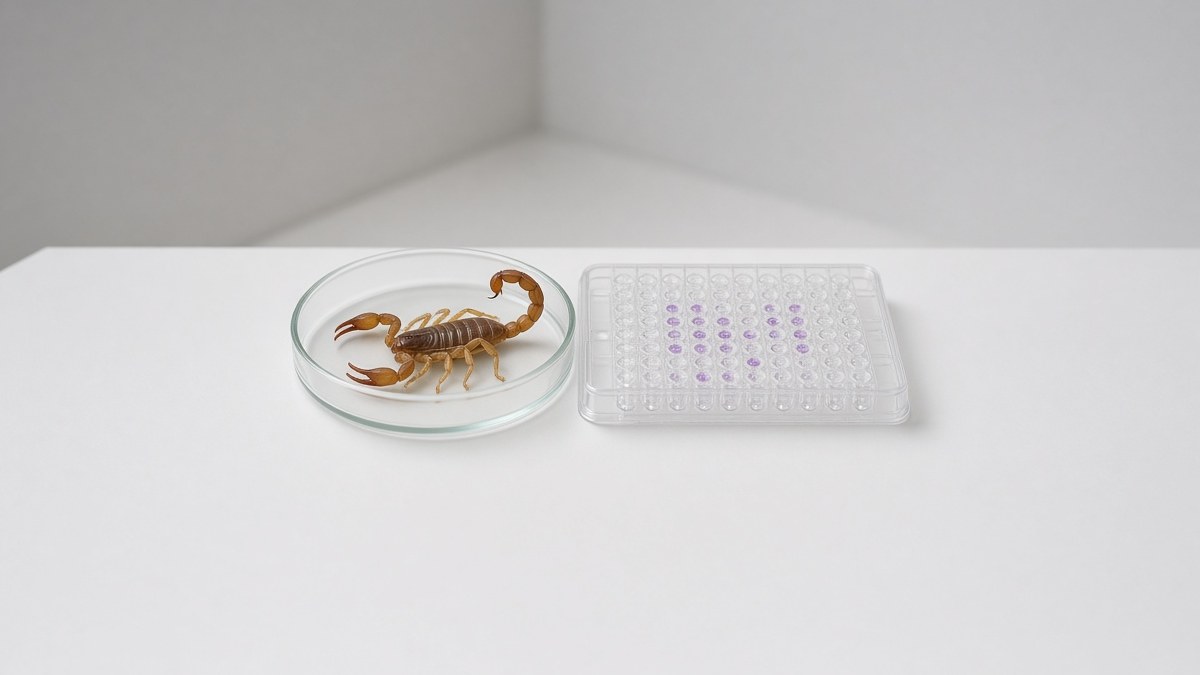
Anthropic said on October 20, 2026 that an internal research model operating within Claude Science designed protein minibinders against scorpion neurotoxins—and that contract labs later confirmed 17 of 211 tested designs met Anthropic's binding criteria. The company is not claiming an antivenom, neutralization in cells, or a drug ready for patients. It is arguing that AI-assisted binder design, paired with fast wet-lab validation, could eventually help neglected envenomation diseases where traditional drug economics struggle.
Key facts
| Item | Detail |
|---|---|
| Announcement | Anthropic research post — Oct. 20, 2026 |
| Task | Design small proteins (minibinders) that attach tightly to scorpion neurotoxins dangerous to humans |
| Model run | 64 hours, largely autonomous; 318,484 designs generated; 180 selected for testing plus 31 more with Claude's help (211 total) |
| Lab testing | Adaptyv Bio and Twist Bioscience; binding measured by surface plasmon resonance (SPR) |
| Hits | 17 binders met criteria—each against one of four toxins (none bound more than one toxin) |
| Per-toxin count | 7 Cn2, 4 AaH II, 4 AaH I, 2 LqhIII (LqhIII tested at Adaptyv Bio only) |
| Not claimed | Venom neutralization, cellular protection, or an approved antivenom |
| Data | All 211 designs released on Hugging Face and Proteinbase |
What Anthropic announced
In a post titled "How Claude designed protein binders against scorpion neurotoxins," Anthropic described the work as part of its broader exploration of how Claude can accelerate drug discovery. The team used an internal research model inside Claude Science, starting from Anthropic's prompt and four follow-up prompts developed with the financial and investment research firm Citrini Research.
Citrini had asked whether Claude—and AI drug discovery more generally—could let motivated nonexperts tackle a genuine human-health problem. The scorpion campaign builds on Anthropic's August study in which Claude designed minibinders from a single prompt; here the question was whether a longer, supervised run could produce credible binders against several hard neurotoxin targets and survive real lab tests.
Over roughly 64 hours, the model worked mainly on its own. Under human supervision, Claude analyzed data, generated figures, and drafted the final technical report Anthropic published alongside the blog post and dataset.
How Claude ran the campaign
Minibinders are compact proteins engineered to latch onto a specific molecular target. For this project, the targets were scorpion neurotoxins implicated in human illness—molecules that are medically important but, Anthropic notes, often fall outside the usual blockbuster drug pipeline.
The scale of the computational campaign was large by design: Claude generated 318,484 protein designs, then narrowed the set to 180 candidates for experimental testing. Researchers added 31 more designs with Claude's assistance, yielding 211 sequences sent to contract research organizations.
Adaptyv Bio and Twist Bioscience synthesized and tested all 211 for binding. The public dataset on Hugging Face documents that binding was assessed with SPR, a standard biophysical technique that measures how tightly a protein attaches to its target.
What the lab tests found
Of the 211 designs tested, 17 met Anthropic's binder criteria. Each successful binder recognized one of four scorpion neurotoxins; Anthropic states that none of the designs made against multiple toxins met its criteria for more than one.
The per-toxin breakdown in the released dataset is:
- 7 binders against Cn2
- 4 against AaH II
- 4 against AaH I
- 2 against LqhIII (tested at Adaptyv Bio only)
Binding in a biophysical assay is a meaningful milestone—it shows the designed proteins actually engage the toxin in vitro—but it is only an early step on a long path toward a safe, affordable treatment. Anthropic has not confirmed whether these binders neutralize venom in a cellular environment.
Two outside experts, Susana Vázquez Torres and Timothy P. Jenkins, reviewed the work for Anthropic and said they considered it a promising first step. Susana Vázquez Torres, a postdoctoral researcher at Spain's CNIO, put the shift in blunt terms in Anthropic's post: "Designing a binder against almost any target no longer seems unrealistic. We can now obtain very tight binders remarkably quickly, and binding itself is no longer the main bottleneck."
Why scorpion stings matter
Scorpion envenomation is easy to overlook in wealthy health systems but devastating where care is scarce. Anthropic cites figures that scorpions sting 1.2 million or more people each year, causing more than 3,250 deaths, mostly among children in parts of the world with limited access to medical care. Anthropic notes that scorpion envenomation has been described as a neglected tropical disease.
Existing antivenoms can work, but Anthropic emphasizes that new therapies are expensive to develop and often unlikely to earn back their costs.
What this is not
Anthropic is explicit about limits. The company does not claim an antivenom, does not assert that the binders block toxicity in living systems, and does not describe a product roadmap for clinics. Confirmed SPR binding is a research result—a starting point for toxinology and protein engineering labs, not a patient-ready intervention.
Turning a tight binder into a safe, affordable drug remains the hard part. Anthropic writes that if AI can design credible binders against difficult toxins in days and confirm them in the lab within weeks, discovery for envenomation and other neglected conditions could, in theory, speed up; the challenge, Anthropic adds, is turning binders into safe, affordable, widely accessible drugs.
Open data for researchers
Transparency is central to how Anthropic positioned the release. All 211 designs and associated measurements are public:
- Hugging Face dataset: Anthropic/scorpion-toxin-binder-design
- Proteinbase: Claude-designed binders against scorpion neurotoxins
- Technical report PDF
Why it matters for AI drug discovery
The scorpion binder story landed on the same day OpenAI said it had acquired Orchestra Bio, a drug-development platform, to combine with its Rosalind life-science tools—another signal that major AI labs are moving from coding assistants toward regulated biology workflows. Anthropic's experiment is different in shape (a supervised research model plus CRO partners, not an acquisition), but the directional overlap is clear: prove that AI systems can propose molecules worth spending real lab dollars on.
For Anthropic context, see our pieces on Claude and the NIST curve-seed mystery and Anthropic hiring versus AI agents. If binding is no longer the bottleneck, safety, delivery, and economics are next.
Sources
- Anthropic: How Claude designed protein binders against scorpion neurotoxins — Oct. 20, 2026
- Anthropic technical report: De novo design of protein binders against scorpion toxins with Claude (PDF) — Oct. 20, 2026
- Hugging Face: Anthropic/scorpion-toxin-binder-design
- Proteinbase: Claude-designed binders against scorpion neurotoxins
- OpenAI: OpenAI acquires Orchestra Bio — Oct. 20, 2026