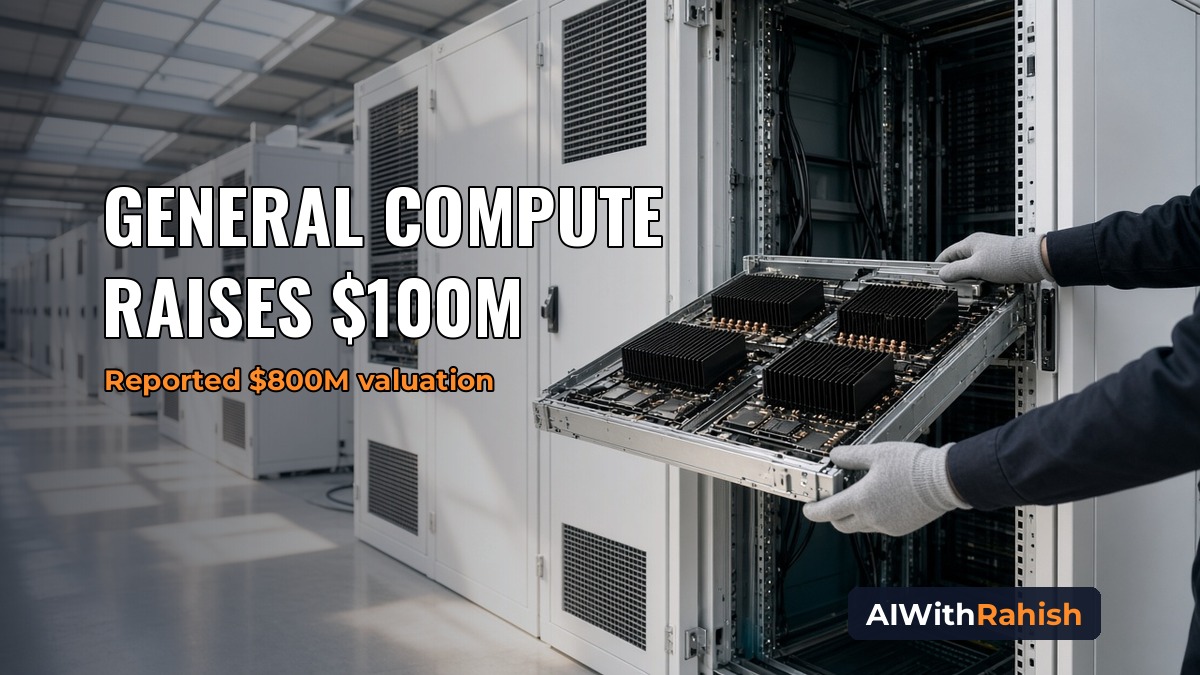
On October 27, 2026, General Compute announced a $100 million Series A, according to its company blog and a WebWire press release. The round was co-led by Blackbird and Abstract, with participation from Fuse Venture Partners, Village Global, and others; the release also names Bold Capital, QED Investors, 645 Ventures, Carbide Ventures, Uncorrelated Fund, Endeavor Catalyst, Icehouse Ventures, MatterScale, Carya, Plug and Play, and additional angels. The financing builds on General Compute's previously announced $400 million debt facility from Upper90 and its chip partnerships with Cerebras, SambaNova, and Positron AI.
TechCrunch reports the company is now valued at $800 million post-money, up from a $60 million valuation after a May seed round—figures the company did not include in its own announcement. TechCrunch also says a large customer deal worth $100 million in annual recurring revenue helped pave the way for the Series A; treat that contract detail as TechCrunch's reporting unless General Compute confirms it separately.
Key facts
| Item | Detail |
|---|---|
| Round | $100M Series A (announced Oct. 27, 2026; General Compute / WebWire) |
| Post-money valuation | $800M (according to TechCrunch; not in company release) |
| Prior valuation | $60M after May 2026 seed (TechCrunch) |
| Co-leads | Blackbird and Abstract |
| Other investors | Fuse Venture Partners, Village Global, and others per release |
| Debt | $400M debt facility from Upper90 (company); TechCrunch framed related financing as a SambaNova chip purchase deal |
| Product | Inference cloud for ultra-fast tokens—GPUs plus purpose-built inference chips from Cerebras, SambaNova, and Positron AI |
| Consumption | Dedicated bare metal or a guaranteed tokens-per-second SLA (company) |
| Capacity | 50+ MW in the pipeline (company); TechCrunch cites 75 MW deployed in 2027 and access to roughly 200 MW of power |
| Go-live | First major deployments in Q1 2027 (company) |
| Leadership | CEO Finn Puklowski; CTO Jason Goodison (WebWire) |
What General Compute sells
General Compute describes itself as the world's first heterogeneous inference cloud. Instead of asking customers to buy and operate their own accelerators, it finances, deploys, and operates a mixed fleet—standard GPUs alongside inference-specific systems from Cerebras, SambaNova, and Positron—and routes workloads to the silicon that fits each stage. Customers can buy compute through a guaranteed tokens-per-second SLA or as dedicated bare metal, without procuring colocation, cooling, networking, or chip financing themselves.
The WebWire release positions the company as bridging a gap: frontier labs are shifting spend from training toward inference, but deploying alternative chips still requires datacenter space, routing software, and capital. General Compute's model is to buy hardware, place it in colocation, and operate the stack—cooling, networking, energy, and software included—under one contract. It says customers can route multi-stage agentic workloads to the architecture that runs each step best, with open-source-compatible stacks that can run models from major frontier labs as well as open-weight releases.
Its press materials claim customers can see large speedups versus GPU-only paths; the release subhead cites results up to 40x faster than GPUs, while its feature list says up to 20x faster results—conflicting multiples that should be read as the company's own marketing claims, not independent benchmarks. The underlying point is still strategic: as inference becomes the dominant AI spend line, buyers want specialized silicon without becoming infrastructure financiers overnight.
Debt, chips, and distribution
General Compute's Series A sits on top of balance-sheet work it had already started. The company says it recently secured a $400 million debt facility from Upper90 to finance its neocloud buildout; TechCrunch describes related financing as a $400 million deal to purchase new chips from SambaNova, framing it as the first debt financing of inference chips. Either way, the through-line is the same—someone has to underwrite expensive alternative accelerators before revenue catches up.
Partnership announcements with Cerebras, SambaNova, and Positron AI give those vendors a distribution path that does not require every customer to negotiate power, colocation, and financing separately. In the WebWire release, Cerebras CTO Sean Lie said inference performance depends on how the full system is deployed and operated; SambaNova's Liang emphasized economics alongside speed; Positron CEO Mitesh Agrawal highlighted debt financing for purpose-built inference silicon paired with workload-matched cloud offerings. TechCrunch adds that General Compute's early customers include inference-focused clouds that resell high-speed token access—General Compute supplies the bare metal while those platforms layer software and developer tooling on top.
Neocloud timing and strategy
TechCrunch published the news the same week CoreWeave shares hit a 12-month low and neocloud skeptics were loud about consolidation risk. CEO Finn Puklowski told TechCrunch he remains bullish on CoreWeave and that fears of a chip-led collapse are "massively overstated," with inbound demand for TPUs, GPUs, and other accelerators every week. General Compute's wedge is narrower: inference-first capacity built from Nvidia rivals' chips, deployed through smaller power sources, rented datacenter space, and converted former bitcoin-mining sites, rather than greenfield megacampus builds.
That footprint may cap how quickly General Compute chases hyperscaler scale, but TechCrunch argues it also avoids some constraints of building from scratch—when chips arrive, the company expects places to plug them in. Puklowski told TechCrunch that raising capital will stay a major part of his job on both debt and equity.
The National Business Review reported Oct. 28 that Blackbird invested US$30 million of the round, that about a third of the raise came from Australia and New Zealand investors, and that Puklowski is New Zealand–born—useful context for readers tracking Australasian capital in U.S. AI infrastructure, though those figures come from NBR rather than General Compute's own materials.
Why investors backed the round
James Palmer, principal at Blackbird, said in the WebWire release that hardware and power now decide who wins in AI infrastructure, and that General Compute's team builds coalitions across those layers. TechCrunch notes Blackbird's confidence is partly informed by its investment in inference platform Baseten, whose growth Palmer has watched closely over the past ten months, alongside rising demand for open-weight inference and companies "owning their own intelligence." David Kwon, partner at Abstract Ventures, said the team executed from pitch to a Cerebras partnership and the Upper90 facility within months.
In the release, Puklowski argued that "the era of one-size-fits-all AI hardware is over" and that specialized silicon will define inference at scale. Executives at Cerebras, SambaNova, and Positron praised the partnership in the release and to TechCrunch, each stressing that raw speed only matters if the economics work—SambaNova CEO Rodrigo Liang told TechCrunch that "everyone in this market is selling speed" but the real question is whether you can make money doing it.
Why it matters
2026's infrastructure narrative is splitting in two: hyperscalers and GPU neoclouds racing for training-scale campuses, and a parallel market optimizing inference latency and cost on alternative chips. General Compute is explicitly in the second camp—financing heterogeneous inference capacity, selling it with SLAs, and stitching together power in unconventional sites while CoreWeave and others absorb public-market volatility.
For developers, the practical question is not which press release multiplier is correct, but whether new clouds can deliver predictable tokens-per-second at prices that survive model churn. A Series A at reported $800 million post-money, layered on Upper90 debt and chipmaker partnerships, is a vote that inference distribution—not just chip design—still has room for new entrants.
What's next
General Compute says its first major deployments go live in Q1 2027, with more than 50 megawatts of capacity in the pipeline. TechCrunch adds a 2027 target of 75 MW deployed and Puklowski's view that the company could access on the order of 200 MW of power—more than it can likely fund and fill with hardware in the near term. For builders shipping agentic apps and open-weight models, the bet is familiar: inference latency and unit economics, not training FLOPs alone, will decide which clouds win the next wave. See also Tenstorrent's $1.5B Series E for another 2026 story about alternative silicon and open-weight inference.
Sources
- General Compute: General Compute Raises $100M Series A — Oct. 27, 2026
- WebWire: General Compute Raises $100M Series A to Build the Inference Cloud for Ultra-Fast Tokens — Oct. 27, 2026
- TechCrunch: General Compute raises $100 million Series A, countering the neocloud disaster narrative — Oct. 27, 2026
- The National Business Review: Kiwi investors join in General Compute's US$100m Series A raise — Oct. 28, 2026