Agents
Google Cloud Announces the Gemini agent at Gemini at Work 2026: A Universal Agent for Enterprise Work
Oct 8, 2026·7 min read·By Rahish Saifi
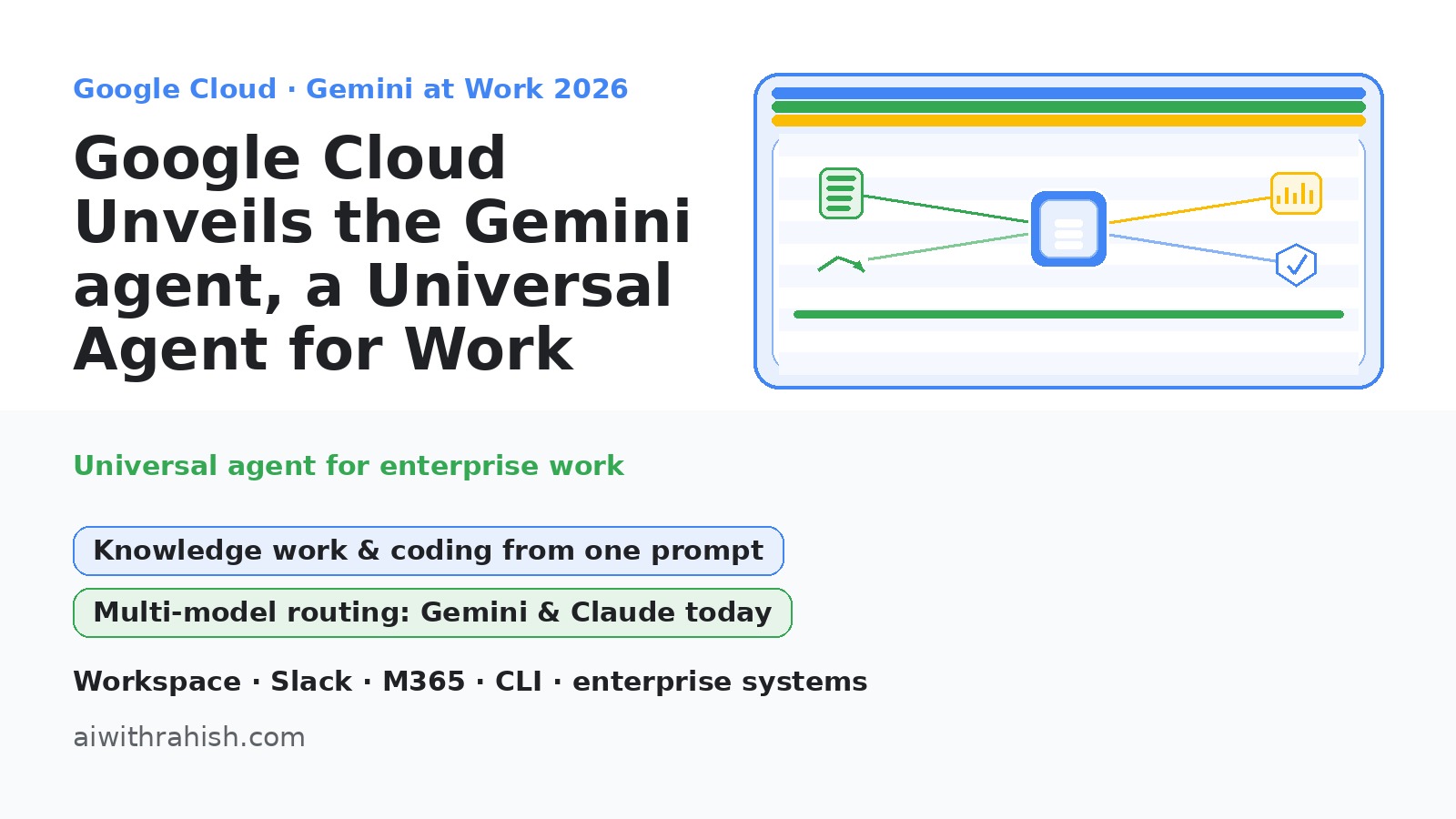
On Thursday, October 8, 2026, Google Cloud used its Gemini at Work 2026 event to announce the Gemini agent, which Google describes as a single, universal agent for work. CEO Thomas Kurian introduced the product in a keynote post on the Google Cloud Blog, and Google’s main newsroom published a shorter announcement the same day.
This is an enterprise announcement framed around Google Cloud customers—not a consumer ChatGPT-style rollout. Google positions the agent inside the same Gemini Enterprise footprint it already sells to large organizations, with emphasis on business context, finished deliverables, and governance rather than a standalone chat toy.
Google held Gemini at Work 2026 in person at Hangar One on Moffett Federal Airfield in Mountain View, California. In his keynote post, Kurian notes that in the last year nearly 500 Google Cloud customers each processed more than one trillion tokens, and that nearly 80% of Google Cloud customers now use Google’s AI products. Per 9to5Google, the agent is available in the Gemini Enterprise app and can be invoked with @Gemini in Gmail, Docs, Sheets, Slides, and Chat.
Key facts at a glance
- What was announced: The Gemini agent at Gemini at Work 2026 on October 8, 2026.
- How Google describes it: A universal agent for work that uses your organization’s business context for knowledge work, Q&A, content creation, and coding from one prompt box.
- Execution model: It plans work, uses skills and tools, connects to business systems, and returns finished output in the documents, inbox, and developer environments teams already use.
- Models: Google says it chooses the best model per job, orchestrating across the Gemini family and Claude models from Anthropic today, with room for other private and open models later.
- Channels: Access from web, iOS, Android, Windows, and Mac, plus the command line, Google Workspace, Microsoft 365, and Slack, with API integration for third-party and headless use.
- Industry specializations: Google says dedicated industry offerings are in preview for Gemini for Financial Services and Gemini Enterprise for Legal, with Government, Healthcare, and Retail coming soon.
- What Google did not spell out: The posts reviewed here do not publish a GA date or public price list for the Gemini agent. According to 9to5Google, it is currently in private preview, with wider availability “soon” for customers on select Google Workspace Business and Enterprise plans.
What Google announced
Google’s framing is deliberate: “Work now starts in the prompt window.” Instead of juggling separate copilots for email, documents, data, and code, Kurian’s post presents one agent that can answer questions, run longer objectives, and generate code through a single interface and a single API. You assign objectives, not step-by-step instructions, and the agent is meant to return completed work rather than a list of suggestions.
The shorter Google newsroom post hits the same pillars: organizational business context, planning plus tools, delivery back into existing surfaces, model choice with built-in cost controls, and the security, administration, and governance enterprise IT expects. Kurian also notes that top customers across industries were early testers—for example, sportswear brand On tested the agent’s dynamic model selection—a signal that this launch is anchored in Gemini Enterprise deployments, not a surprise drop for every Gmail user.
What the Gemini agent is designed to do
Google groups the architecture around a few ideas that matter if you build or buy agent systems:
- Unified agent: Chat, autonomous objectives, scheduled tasks, event-driven work, and code generation from one place.
- Omnipresent access: Same agent across devices and channels, including integrations that let it run as a headless agent without its own UI.
- Persistent execution: Work runs in the cloud with a single set of memories, context, and a personalization graph, so long-running jobs continue after you close a laptop.
- Multi-agent orchestration: Gemini can spin up sub-agents for multi-step jobs or act as a coworker agent with a persistent role. Coworker agents can receive dedicated identities—including @agents.company.com email addresses and their own storage—under permissions you grant.
- Deep context: Google says the agent arrives knowing your tools, data, and work history, and teams can scope projects to tune context, skills, and tools further.
Skills, tools, and memory
On the plumbing side, Google highlights three enablers:
- Tools and a tools registry to reach systems such as Confluence, Microsoft Office, Teams, Slack, Workspace, Git, Jira, Salesforce, ServiceNow, BigQuery, Databricks, Postgres, Snowflake, desktop files, and MCP servers inside or outside the corporate network.
- Skills and a skills registry—reusable instruction and workflow modules—with a global library plus a shared company registry and personal skills.
- Four memory types: session (including long-running tasks), semantic, procedural, and episodic memory, which Google compares to how a new hire learns people, tools, and norms over time.
Gemini inside Google Workspace
A major slice of the keynote is inline Workspace behavior. Google says Gemini works inside Gmail, Drive, Docs, Slides, Sheets, Chat, and Calendar with the same memory, skills, and controls as elsewhere—scheduling meetings from chat context, building models and decks across apps, or surfacing inbox priorities with explanations.
Workspace also gets a coworker agent pattern: describe a role, and Gemini can provision an agent with its own Workspace account, calendar, Drive, and directory presence so teammates collaborate with it like a colleague—with access limited to what the team shares.
Data, industry specializations, and cost controls
Google bundled several adjacent launches into the same keynote narrative:
- Data and analytics skills for engineers (plain-language PySpark, notebooks, pipeline fixes) and business users (operational reports grounded in BigQuery and the Knowledge Catalog).
- Industry specialization with dedicated skills and connectors—in preview for Gemini for Financial Services and Gemini Enterprise for Legal today.
- Cost controls including multi-model orchestration, Smart Routing, and real-time spend caps in Cloud Billing that can pause a project’s agent when a cap triggers.
Who gets it and what availability means
Read the announcement as Google Cloud enterprise AI, not a free tier upgrade. Kurian’s post is explicit that large organizations already run on Gemini Enterprise—he cites nearly 90% of the Fortune 100 using it—and the announcement leans on those existing Gemini Enterprise customers, partner hackathons, and programs for context—though those deployments predate the Gemini agent itself.
Google cites early testers among top customers (naming On, which tested dynamic model selection) but does not, in the primary posts cited here, give a single public “GA for all Workspace editions” checklist or consumer pricing. The clearest availability language in the keynote is for industry-specific Gemini (preview in Financial Services and Legal; more industries coming soon). 9to5Google reports the agent is in private preview today, with wider availability coming soon to select Workspace Business and Enterprise plans. If you are evaluating access, start with your Google Cloud account team or existing Gemini Enterprise or Workspace agreement rather than assuming the agent is on by default.
Why it matters
Google is betting that enterprise AI consolidation wins over a dozen narrow copilots. A universal agent with registries for tools and skills, persistent cloud execution, and explicit identity plus audit trails is an answer to the question CIOs have been asking since 2024: how to let agents act without losing control.
The multi-model orchestration message is equally strategic. By routing jobs across Gemini and Claude today—and promising more models later—the bet is that customers will not accept single-vendor lock-in for every task, while still keeping context and skills in Google’s stack. Pair that with Agent Sandbox execution and Agent Gateway policy enforcement, and you get a picture of agents treated like employees with badges, not anonymous API keys.
For builders, the Workspace and headless API paths matter: the same agent is supposed to meet users in email and docs while also embedding into line-of-business apps. That is a different integration burden than “paste your API key into a sidebar,” and it is where Google hopes Gemini Enterprise becomes the default control plane.
What to watch next
Rollout clarity: Watch for Google to publish edition-level availability for the Gemini agent beyond keynote language and early testers—especially which Workspace and Cloud SKUs turn it on by default.
Industry previews: Financial Services and Legal previews will be the first test of whether specialized skills and compliance artifacts (lineage, citations, ethical walls) match how regulated teams actually work.
Governance in production: Agent identities, spend caps, and Gateway policies sound strong on paper; the proof is whether security teams can operationalize them without one-off exceptions for every department.
Model mix: As Google adds more third-party and open models to orchestration, compare total cost and quality against running those models directly—Smart Routing only helps if telemetry is transparent.
If you are mapping Google’s 2026 agent stack, pair this with Gemini in Chrome auto browse for subscribers on the consumer side and building your first agent on the engineering side—the enterprise and browser stories are converging, but the gates are very different.