LLMs
Mistral Large 4 “Le Chonk” Launches in Preview: 1T Parameters, Open Weights Due This Month
Oct 7, 2026·5 min read·By Rahish Saifi
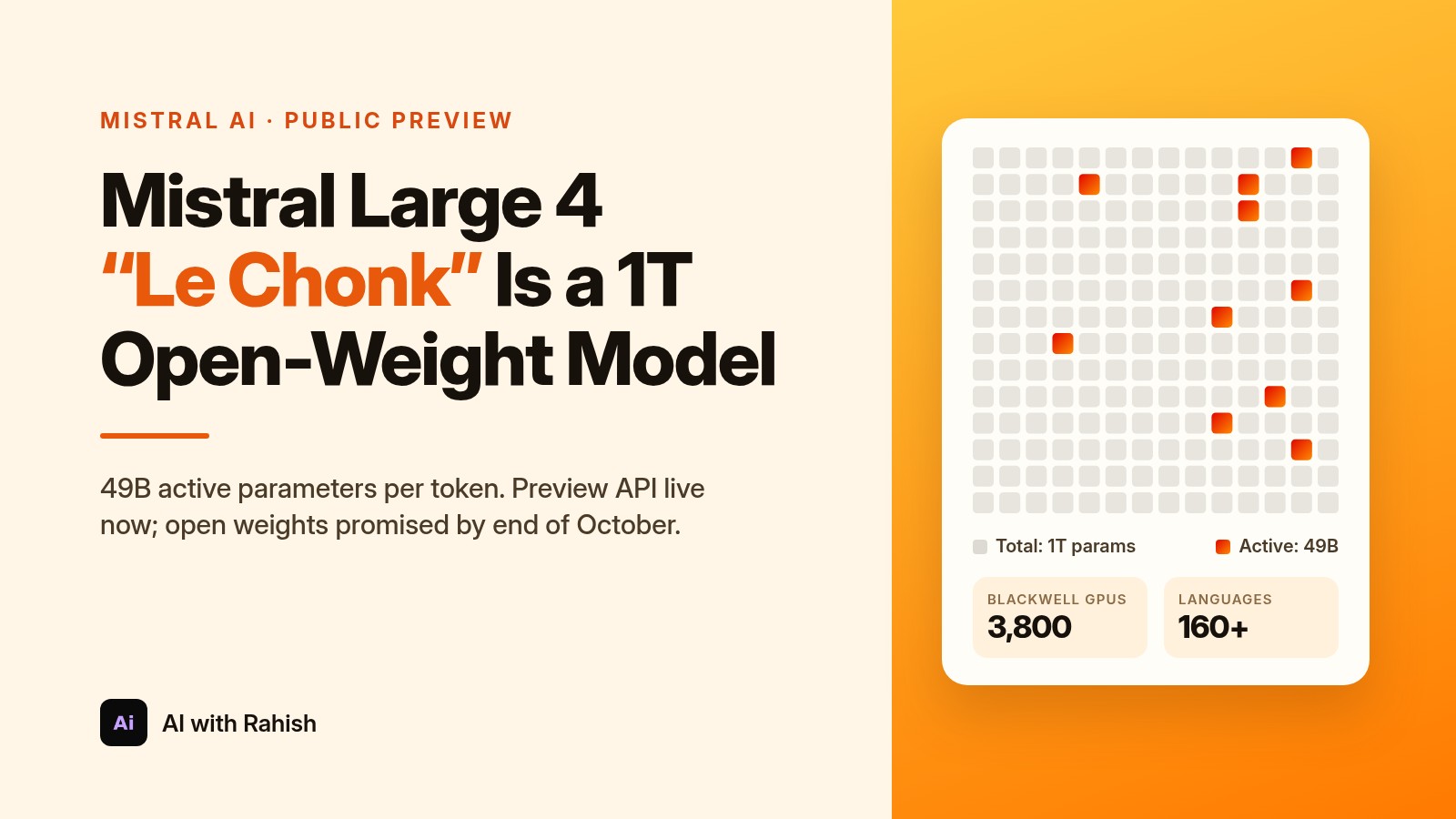
Mistral AI has put its biggest model yet into the hands of developers. On October 6, 2026, the Paris-based lab launched a public preview of Mistral Large 4, a 1-trillion-parameter natively multimodal model that it calls ML4 and, “very officially,” Le Chonk. The preview API is live on Mistral Studio today, and Mistral says the open weights drop by the end of this month.
The pitch is simple: frontier-class performance that companies and governments can eventually download, run, and control themselves, built and served in Europe.
What Mistral announced
- Size: 1 trillion total parameters, with 49 billion active per token. Mistral’s Hugging Face placeholder adds that the figure is 52 billion when embeddings and output layers are counted.
- Architecture: a sparse mixture-of-experts (MoE) design, so only a small slice of the network runs for each token. That keeps serving costs far lower than the headline size suggests.
- Inputs and outputs: Mistral calls ML4 natively multimodal. Co-founder Guillaume Lample told VentureBeat that it accepts multimodal inputs but still produces text output.
- Availability: a preview API on Mistral Studio now. Weights are promised by month-end. VentureBeat reported an October 27 target, and the Hugging Face page currently lists an October 31 ETA.
- Languages: a large share of training data spanned more than 160 languages, including every official language of the European Union.
Built on 3,800 Grace Blackwell GPUs in Europe
Mistral says ML4 was trained from scratch on 3,800 NVIDIA Grace Blackwell GPUs in its own European datacenters. The preview runs on that same infrastructure. The Register put that at around 52 NVL72 racks.
The company also plans a European deployment that it operates end-to-end, independently of other digital service providers and under European law. For regulated industries and public-sector buyers, that sovereignty angle may matter as much as any benchmark.
The benchmark claims, by Mistral’s numbers
All of these figures come from Mistral’s launch post and have not yet been independently reproduced on the final model:
- Agentic coding: 61.7% on DeepSWE v1.1, 59.4% on SWE-Atlas-QnA, and 28.3% on Terminal-Bench 4. Mistral puts its Coding Agent Index score of 49.8% ahead of DeepSeek V4 Pro 0813 and Qwen3.8 Max.
- Business workflows: 59.9% on AutomationBench, which covers 657 workflows across apps like Gmail, Google Sheets, Slack, and Salesforce.
- Cybersecurity: 93% of Cybench’s 40 challenges, plus 82% on an Artificial Analysis Cyber Index test that asks a model to reproduce a real vulnerability and then patch it. Mistral says that is the highest score of any model, and that several closed models score near zero there because they refuse the task.
- Vision: 42% on the Dense 200 visual-grounding test, versus 41% for GPT-6 Astra.
- Human evaluation: in a blind coding-quality test run with Surge AI, ML4 Preview ranked second of five models (3.74 out of 5), behind only Claude Opus 5 (4.22).
- Safety: it resisted 93.3% of attacks on Lakera’s B3 AI Security Benchmark.
The independent picture is more mixed
Outside reporting adds useful context. VentureBeat noted that the live DeepSWE leaderboard, which picks each model’s best published setup, puts GLM-5.3 and Kimi K3 at about 69% and models like GPT-6 Astra and Claude Opus 5 around 74%. So ML4’s 62% is competitive, but it is not an outright coding lead.
The Register reported that early testing by Artificial Analysis places the preview between DeepSeek V4.1 Flash and OpenAI’s entry-level GPT-6 Luna on its intelligence leaderboard. That is well behind the top closed flagships, but The Register said ML4 still beats Thinking Machines Lab’s Inkling, which it called the most capable US open-weight model, by a significant margin.
The fair read: Mistral’s claim that ML4 beats every open-weight model built in the US or Europe looks plausible, but top Chinese open models and US closed flagships remain the bar to beat.
Why it matters for AI builders
- A real Western open-weight option at the frontier. Once the weights land, teams that need on-prem or private-cloud deployment get a 1T-class model that is not from a Chinese lab.
- Security teams get fewer refusals. Mistral argues that provider-level refusals can block legitimate vulnerability research and incident response. Self-hosted weights let organizations set their own policies.
- Licensing still needs a close look. VentureBeat reported the weights are expected under a custom Mistral license, and that API pricing was not included in the launch materials it reviewed. Check both before you plan production use.
- Hardware is serious but not exotic. The Register estimates the model can run reasonably on 8-way GPU servers such as NVIDIA’s HGX B300 or AMD’s MI355X.
What happens next
Until the weights ship, Mistral is red-teaming ML4 with cybersecurity leaders, vetted partners, and state authorities. Mistral says it will also publish more on the architecture, additional benchmarks, and its post-training method.
Mistral also says the reinforcement learning run behind the preview is “still in flight,” with no signs of saturation, so the final checkpoint may score higher than today’s preview. ML4 is the first milestone on the roadmap funded by the company’s €3 billion Series D, and it will serve as the base for a new generation of specialized Mistral models.
The date to watch is the weights release later this month. That is when independent testers can verify Mistral’s claims on their own hardware.