LLMs
NVIDIA DGX Spark 64GB Targets Local Agents Starting at $4,999
Oct 6, 2026·4 min read·By Rahish Saifi
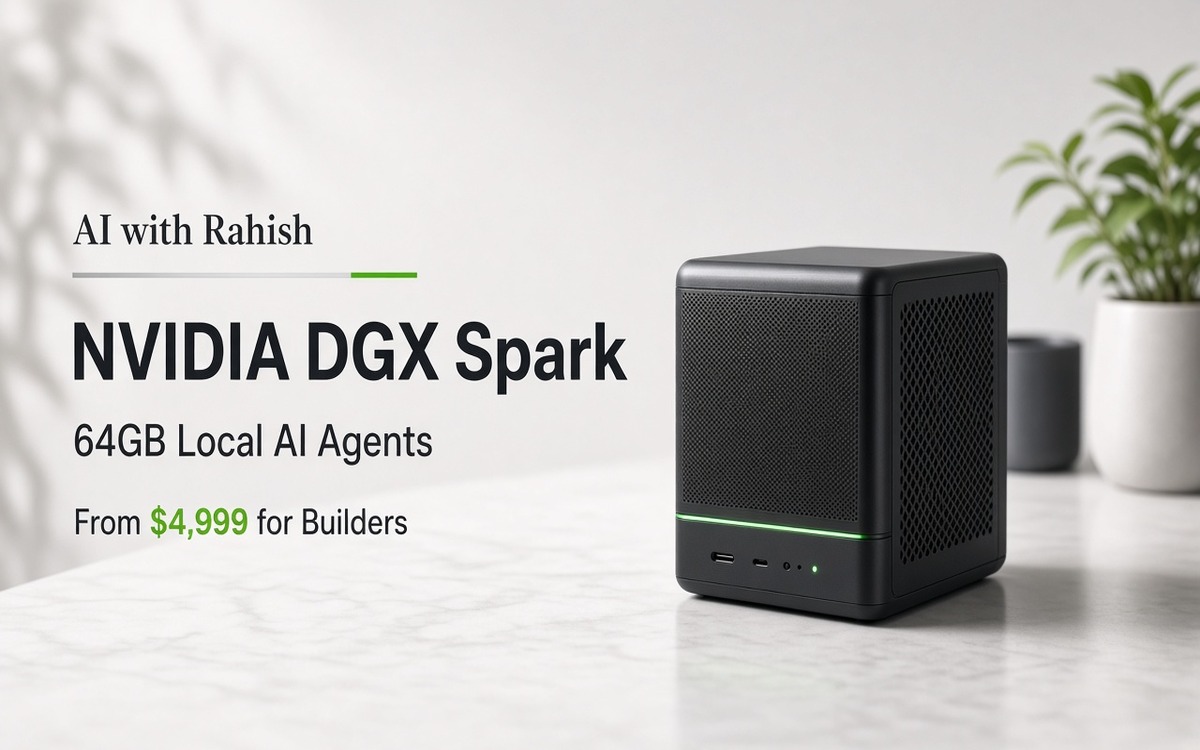
In an October 2, 2026 blog post, NVIDIA announced a 64GB unified memory configuration of DGX Spark, the compact Grace Blackwell “personal AI supercomputer” line. Systems from Acer, ASUS, Dell, Gigabyte, HP, and MSI are scheduled to ship starting Friday, October 23, 2026, with pricing from $4,999.
The pitch is local agent development without routing every experiment through cloud GPUs—and a clearer on-ramp for builders who do not need the existing 128GB SKU.
What the 64GB SKU includes
NVIDIA says the new configuration keeps the GB10 Grace Blackwell Superchip, DGX OS, and full NVIDIA AI software stack—the same foundation as the 128GB model. It supports up to 100-billion-parameter models and agentic applications entirely on device.
Hardware highlights repeated in the post:
- Built-in NVIDIA ConnectX-7 networking on every unit.
- Two units can connect via QSFP cable, pooling memory to 128GB and expanding support to models up to 200 billion parameters.
- In NVIDIA’s Qwen 3.8 27B test, two clustered 64GB systems delivered up to 1.7× performance versus a single unit.
NVIDIA Sync and the operator experience
Every DGX Spark ships with the NVIDIA Sync app. Its Cluster Assistant detects connected units, validates configuration, and sets up ConnectX-7 networking so developers avoid manual cluster wiring.
NVIDIA also teased Sync Model Launcher for late October 2026: download and run Qwen3.8 27B on one device or a cluster, expose it to laptops on the network, and wire OpenCode for browser-based coding against the local model.
Out-of-the-box software mentions include NVIDIA Agent Toolkit, CUDA-X libraries, Nemotron open models, and runtimes such as Ollama, vLLM, and PyTorch.
Who this is for
NVIDIA frames three workflows: always-on coding or research agents on local hardware; offloading inference from everyday laptops while keeping PCs responsive; and scaling from one unit to two when context length, model size, or concurrent agents outgrow 64GB.
Partner systems like ASUS Ascent GX10 64GB echo the same story—30–35B-class open models on one box, larger quantized models when two systems cluster.
Implications for cloud-first teams
Local Spark boxes will not replace hyperscale training, but they change the dev loop for agents that touch proprietary data: iterate on prompts, tools, and small fine-tunes without egress fees. If your security team blocks cloud inference for certain document classes, a Spark tier may be cheaper than bespoke on-prem racks—provided you budget for power, cooling, and model licensing.
Software stack and creator tooling
NVIDIA’s post highlights day-one support for agent frameworks and inference servers developers already use—Ollama, vLLM, llama.cpp, and LM Studio appear in the getting-started guidance. Agent playbooks on build.nvidia.com cover NemoClaw, OpenClaw, Hermes Agent, and OpenShell, with additional Spark playbooks listed as coming soon for vLLM serving and multi-node OpenClaw setups.
Blender is called out as an early creator-app partner with a prebuilt installer planned—an example of how NVIDIA is positioning Spark beyond LLM chat: local media and 3D workflows that can call models on the same box.
RTX Spark PCs and the broader local-AI push
The same announcement notes upcoming RTX Spark Windows PCs from major OEMs and Alibaba’s Qwen-Image-2.1 running locally on RTX GPUs and DGX Spark. The through-line is consistent: reduce dependence on always-on cloud inference for experimentation, then burst to cloud when jobs exceed device memory.
Buying guidance for engineering leads
Choose 64GB when your target models fit comfortably under 100B parameters with the quant formats you accept, and when you primarily need a dedicated inference box for agents that should not leave the office network. Stay on 128GB—or plan a two-node cluster from day one—when you routinely fine-tune, run multiple concurrent agents, or experiment with 200B-class models after pooling memory.
Remember that clustering requires ConnectX-7 cabling and NVIDIA Sync; budget for that hardware alongside the second unit. NVIDIA’s Qwen 3.8 27B benchmark is a useful reference point, but your own agent stack (context length, tool payloads, vision attachments) should drive sizing—not marketing slides alone.
Bottom line
The 64GB DGX Spark is NVIDIA’s answer to “local agents are useful, but 128GB pricing is steep.” With $4,999 entry hardware, one-click clustering, and launcher tooling on the way, the platform push is clear: treat personal AI supercomputers as the default dev bench for open-weight agents—not only a cloud afterthought.