LLMs
GPT-6.1 Sol Lands in the API With Near-Astra Coding at Lower Token Prices
Oct 6, 2026·4 min read·By Rahish Saifi
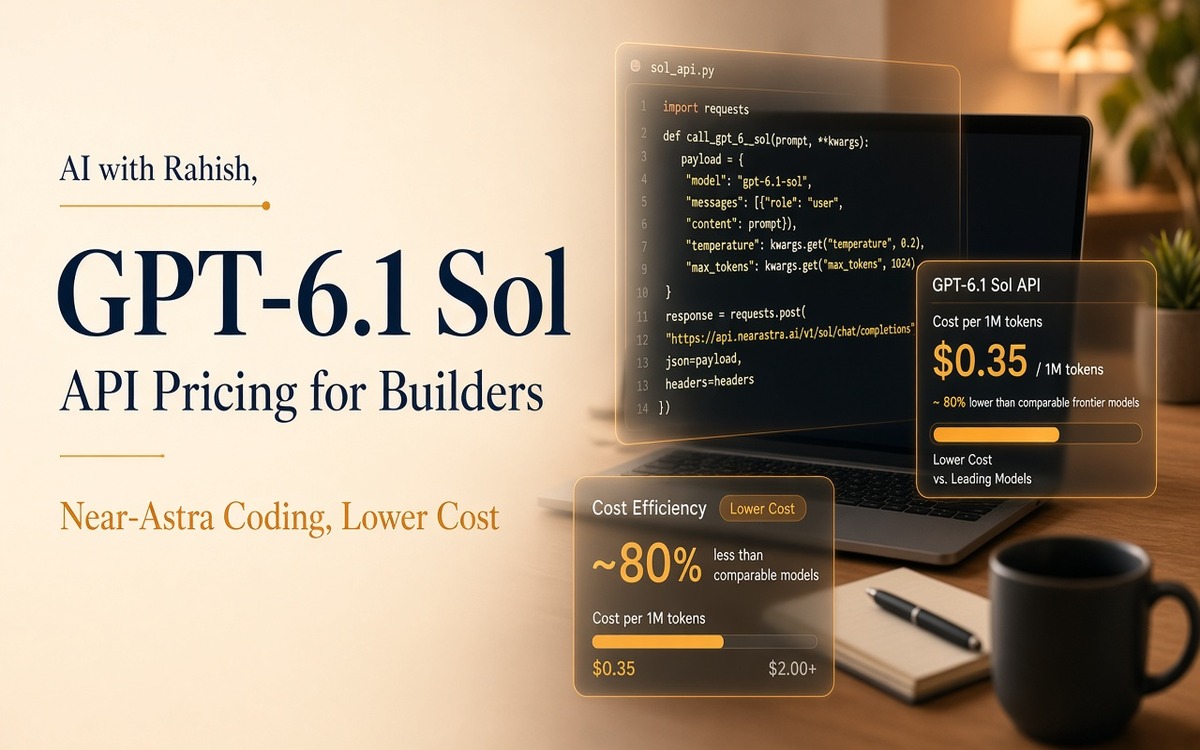
OpenAI unveiled GPT-6.1 Sol at DevDay 2026 as a workhorse model for complex coding, computer use, and professional tasks, with documentation on developers.openai.com positioning it as delivering near-Astra performance at lower cost. For teams running agent loops at scale, the interesting question is not whether Sol beats Astra on every benchmark—it is whether your workload can trade a small quality margin for materially cheaper tokens and still pass production evals.
Specs developers can verify today
According to OpenAI’s model page, GPT-6.1 Sol includes:
- 1,050,000-token context window and 128,000 max output tokens.
- April 30, 2026 knowledge cutoff.
- API id
gpt-6.1-solwith reasoning effortslowthroughmax(noneandminimalnot supported). - Computer use, function calling, structured outputs, MCP, code interpreter, hosted shell, and related Responses API tools.
- US and EU data residency support (fast mode unavailable with EU residency).
Pricing and caching
Standard text pricing on the model page (per 1M tokens):
- Input $2.00, output $10.00.
- Cached input $0.10 (5% of uncached input rate).
- Cache writes $2.50 (1.25× uncached input).
- Prompts with more than 272K input tokens reprice the full request at 2× input/cache and 1.5× output.
- Fast mode is 2× standard; batch and flex are 50% lower than standard.
OpenAI’s launch messaging describes Sol as roughly one-fifth of GPT-6 Astra’s standard API input and output prices for comparable work—a positioning statement teams should validate on their own eval suites before migrating production traffic.
Where Sol fits in the stack
Sol is explicitly aimed at coding and computer-use agents—the same loops where latency and cost compound across tool calls. OpenAI notes that Chat Completions is supported without tool calling, while the Responses API is the path for tool use. That split matters if you are mid-migration from legacy chat endpoints.
Availability includes the OpenAI API and, per DevDay communications, ChatGPT Work and Codex for eligible paid and organizational plans—not necessarily the default model in ordinary ChatGPT chat for all tiers.
Practical migration checklist
- Re-run golden tasks on Sol versus Astra with identical prompts and tools; track pass rate, not vibes.
- Turn on caching for stable system prompts and tool schemas—cached input at $0.10/M can dominate savings.
- Watch long-context surcharges past 272K tokens; agent transcripts blow past that faster than chat UIs suggest.
- Align reasoning effort with task risk; higher effort increases quality and billable reasoning tokens.
How Sol compares to Ultrafast and Astra
OpenAI is segmenting the GPT-6 family by economics and latency, not just capability. Astra remains the top tier for the hardest judgment calls; Ultrafast optimizes token generation speed on NVIDIA Blackwell for tight agent loops; Sol targets the bulk of coding and computer-use traffic where cost per successful task matters more than peak benchmark scores.
That triage mirrors how mature ML teams already route queries: a small slice of traffic to the frontier model, a larger slice to a mid-tier model, and deterministic code paths for everything else. Sol’s 1.05M context window also makes it a plausible default for repository-scale analysis—provided you monitor the 272K pricing cliff.
Enterprise considerations
EU data residency support without fast mode is a real constraint for European deployments that need both compliance and snappy UX—plan dual stacks or accept higher latency. OpenAI’s documentation also notes regional processing premiums where available; finance teams should model those surcharges before signing multi-year agent roadmaps.
Rate limits on the model page scale with usage tier—Tier 5 allows up to 15,000 RPM and 40M TPM, which matters if you plan to fan out Sol across hundreds of micro-agents. Load tests should include cache write traffic, not just uncached prompts, because agent harnesses often append large tool outputs that bust cache keys.
Tooling and API surface
Sol’s feature list reads like a checklist for production agents: MCP, hosted shell, apply patch, skills, computer use, and code interpreter on the Responses API. Teams still on Chat Completions should map which tools they lose before migrating endpoints. DevDay messaging also tied Sol to Codex and ChatGPT Work—if your organization standardizes on those surfaces, confirm which plan tiers include Sol before rewriting internal runbooks.
Bottom line
GPT-6.1 Sol is OpenAI’s attempt to give developers an Astra-class coding and computer-use model at a price point that survives high-volume agent loops. Treat “near-Astra” as a hypothesis to test: if your evals hold, Sol may become the default inference target while Astra and Ultrafast handle the hardest or latency-critical slices.