Agents
Runway Praxis-1: Open-Weight World Action Models and What They Mean for AI Builders
Oct 3, 2026·5 min read·By Rahish Saifi
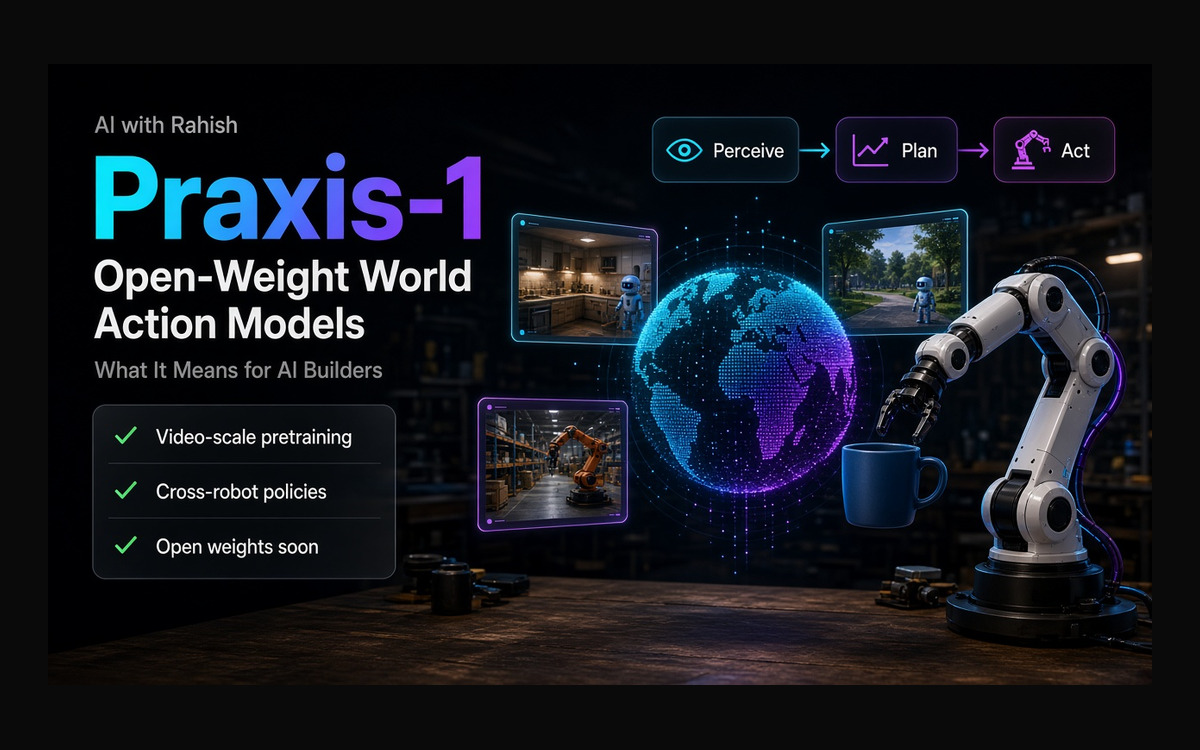
In September 2026, Runway—the company best known for generative video—announced Praxis-1, its first open-weight world action model. The model is built on the same large-scale video pretraining that powers Runway’s general world models, but the output is not pixels on a screen: it is control signals for real robots.
If your day job is LLM apps, agents, or RAG, you might wonder why a video lab’s robotics bet belongs on your radar. The short answer: the same scaling playbook that transformed language and video—pretrain on abundant data, fine-tune lightly for the task—is now being applied to physical policies, with open weights promised for hardware teams that do not want a closed API gatekeeper.
What Runway announced
According to Runway’s research post, Praxis-1 is a generalist policy model meant to work across different robot embodiments and environments. The company is testing it with early partners—Noble Machines (bimanual manipulation), Standard Bots (6-DoF arm on the RO1 platform), and Ultra (mobile base)—each running the model on their own hardware. Runway says it will offer early access to more partners before a public release with open weights in the coming months (no firm date yet).
The demos Runway published show multi-step behaviors in cluttered settings: approaching a shelf, picking up an object, and putting it away, plus a separate clip with the instruction “Pick up the tennis ball and put it in the box.” Those clips are company-produced; treat them as illustrations of intent, not independent benchmarks.
The core idea: learn physics from video, not only from teleop
Robot learning’s classic bottleneck is data. Teleoperated demonstrations are slow and expensive to collect at the scale a generalist policy needs—especially for edge-heavy domains like homes or warehouses. Runway’s argument is that third-person web video is far more abundant than robot logs, and that a model which already understands how objects move and how hands interact with the world starts with a stronger prior than one trained only on action trajectories.
Runway reports empirical support for that story in its post:
- After fine-tuning, web video pretraining reached a final placement error of 16.1 cm, versus 16.0 cm when pretraining on teleoperated robot video—within the error bars Runway published (±1 SEM over 93 evaluation pairs; differences smaller than a bar are not statistically significant).
- Policy performance improves as third-person video scale increases, with the limiting factor becoming how much general video the model can train on—not just robot hours.
- Simulating robot policies inside Runway’s world model correlates with real-world results at 0.95, which Runway compares favorably to more expensive 3D reconstruction–based techniques.
Runway also highlights failure modes for demonstration-only policies—rigid repeated objects, clutter, transparent materials, and deformables like cloth—cases where pure imitation data often breaks. Whether Praxis-1 reliably solves those in the wild is exactly what the partner testing phase is meant to establish.
Why open weights matter here
When Praxis-1 ships publicly, Runway plans to release open weights, not a hosted-only product. For robotics startups and integrators, that is a different commercial shape than renting a closed vision-policy API: you can adapt weights on your own stack, pair them with your sensors and safety layers, and iterate without per-call inference economics.
Runway frames openness as a strategic bet on U.S. “physical AI” and manufacturing competitiveness. Whether you agree with the geopolitics or not, the developer takeaway is familiar from LLMs: open weights plus local control tends to accelerate experimentation on hardware you already own.
What this means if you build software with AI (not robot arms)
1. “World models” are becoming infrastructure, not demos
Runway’s line of work—from interactive world models like Solaris and GWM Worlds 2 to Praxis-1—treats video pretraining as a simulator you can train agents inside. If you build agents today, you already reason about tool APIs and environment state; physical AI pushes the same pattern onto continuous control. Expect more cross-pollination: simulation metrics, correlation-to-real evals, and safety gates before general availability.
2. Data strategy beats model branding
The Praxis-1 story is less “one magic architecture” and more “where does your pretraining signal come from?” That mirrors LLM engineering: curated corpora, synthetic data, and domain adapters matter as much as parameter count. If you are designing an agent pipeline, ask the same question—what abundant signal can you pretrain on before expensive human labels?
3. Embodied AI will surface in your product surface area
Warehouse automation, lab robotics, and device fleets increasingly share a control stack with the ML systems you deploy in the cloud. Even if you never touch ROS, you may integrate with partners who do. Understanding open-weight release models and partner-only eval phases helps you set realistic timelines when a customer asks for “the Runway robot brain” in a pilot.
How to follow the story responsibly
- Read the primary source. Runway’s Introducing Praxis-1 post includes figures on video scale and environment transfer; start there before third-party summaries.
- Separate announcement from availability. Partner tests are underway; public open weights are promised but not dated. Plan pilots accordingly.
- Keep your agent skills sharp in software domains. Tool use, eval harnesses, and observability for LLM agents transfer directly to robotics stacks that mix perception, planning, and control. Our guide on building your first AI agent in 2026 is a practical on-ramp.
Bottom line
Praxis-1 is Runway’s bet that video-scale pretraining can produce robot policies competitive with scarce teleop data—and that releasing those policies as open weights will unlock hardware experimentation faster than a closed cloud-only model. The claims are bold and the public weights are still ahead of us; the direction is clear for builders: physical AI is adopting the same pretrain-and-adapt playbook that reshaped language and video.
Watch Runway’s research channel for a general-availability date. In the meantime, if you build agents or data-heavy ML systems, use Praxis-1 as a case study in scaling laws, simulation correlation, and why openness still changes who gets to ship.