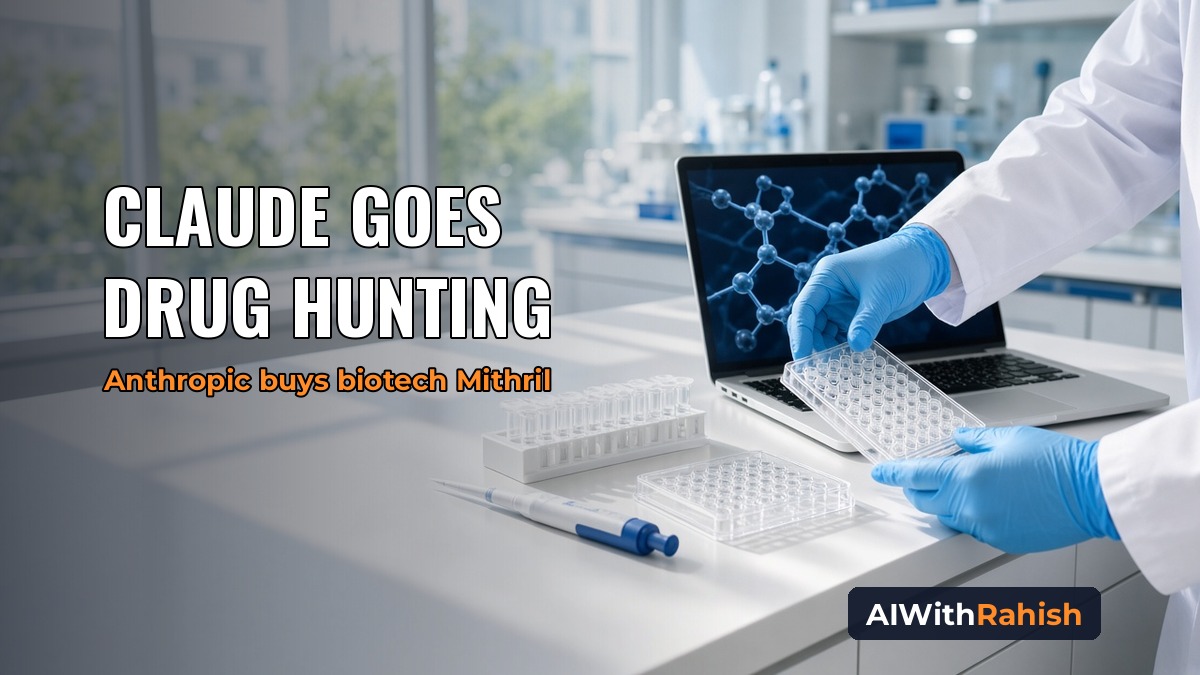
On October 27, 2026, Anthropic published an update on how Claude supports real drug programs—from molecular design to regulatory drafts and trial planning. In a research post, it described partnerships with six organizations—BigHat Biosciences, Bristol Myers Squibb, Divergence Labs, Enveda, Generate Biomedicines, and The Column Group—and disclosed that it acquired Mithril Medicine, a one-person biotech focused on rare muscular dystrophies. A Mithril technical report (October 26, 2026; not peer reviewed) adds detail. Results are early and mostly preclinical; Anthropic does not present them as proven human therapies.
What Anthropic announced
Anthropic's strategy is to embed Claude across the pipeline—targets, design, manufacturing, filings, and trials—so bottlenecks surface in live work. It also rolled out Claude Science, Claude credits for life scientists, a Life Sciences Verification Program, and an open call for guest investigators, and plans to scale partnerships and clinical-stage use as programs advance.
The one-person biotech Anthropic bought
Mithril Medicine, based in Cambridge, Massachusetts, was founded and run largely alone by Cody Tranbarger, according to reporting from R&D World, which noted Anthropic disclosed on October 27 that the deal closed in July. Tranbarger used Claude to organize contracts, logistics, and experiments with 11 external labs, delegating much of Mithril's operational work to the model.
Anthropic says Mithril moved a candidate for one rare childhood form of muscular dystrophy from idea to promising mouse results in under 18 months. Tranbarger is continuing the work inside Anthropic and planning additional programs. If candidates keep performing, Anthropic expects a drug could be ready to enter human trials as soon as late 2028—still a forward-looking timeline, not a completed clinical milestone.
What partners reported
Generate Biomedicines: six scientists used Claude Code on CAR T-cell instructions for solid tumors. One design was about 70% shorter than the standard segment and, in lab tests, yielded roughly 10 times as many receptors plus stronger tumor killing and longer-lived cells.
Divergence Labs: Claude generated about 35,000 antibody designs in about a month for food-allergy work targeting IgE on immune cells. Early tests found three IgE binders and 20 dislodgers; three dislodgers beat the standard medication in those assays.
BigHat Biosciences: about 1,010 variants in about 10 weeks produced leads with more than 10× tighter binding, a cancer-targeting fragment stable 18°C higher in solution, and a longer-lasting lead that clumped more than 100× slower.
Enveda: on 1,061 pages, Claude flagged all 11 issues humans caught plus 7 they missed, cutting review time by 89% (over 25 hours to under three). One regulatory draft took four hours versus about three months manually.
The Column Group is launching Pleiades; its first Claude skill for target assessment was tested on 45 target-disease pairs. Bristol Myers Squibb uses Claude to review early clinical trial plans and estimate success odds, with broader work planned in 2027. Michael Pourdehnad, MD, Senior Vice President, Head of Early Clinical Development, Hematology, Oncology and Cell Therapy at BMS, said:
"We use Claude at the clinical trial stage to analyze proprietary data, create a clinical study plan, and weigh the study's chance of success. From a single prompt, Claude generated a robust initial analysis that helped inform our assessment of different development options, which would otherwise take days to complete. We did all of this while ensuring the security of our highly sensitive data. We look forward to expanding this work across our pipeline to support portfolio-level decisions."
Caveats and what's next
Anthropic states plainly that this research is still early and largely preclinical—not a slate of approved drugs. Lab metrics, document automation, and trial-planning drafts still need validation in humans and with regulators. The company plans deeper clinical partnerships, continued Mithril programs, and wider researcher access while tracking whether these trajectories hold.