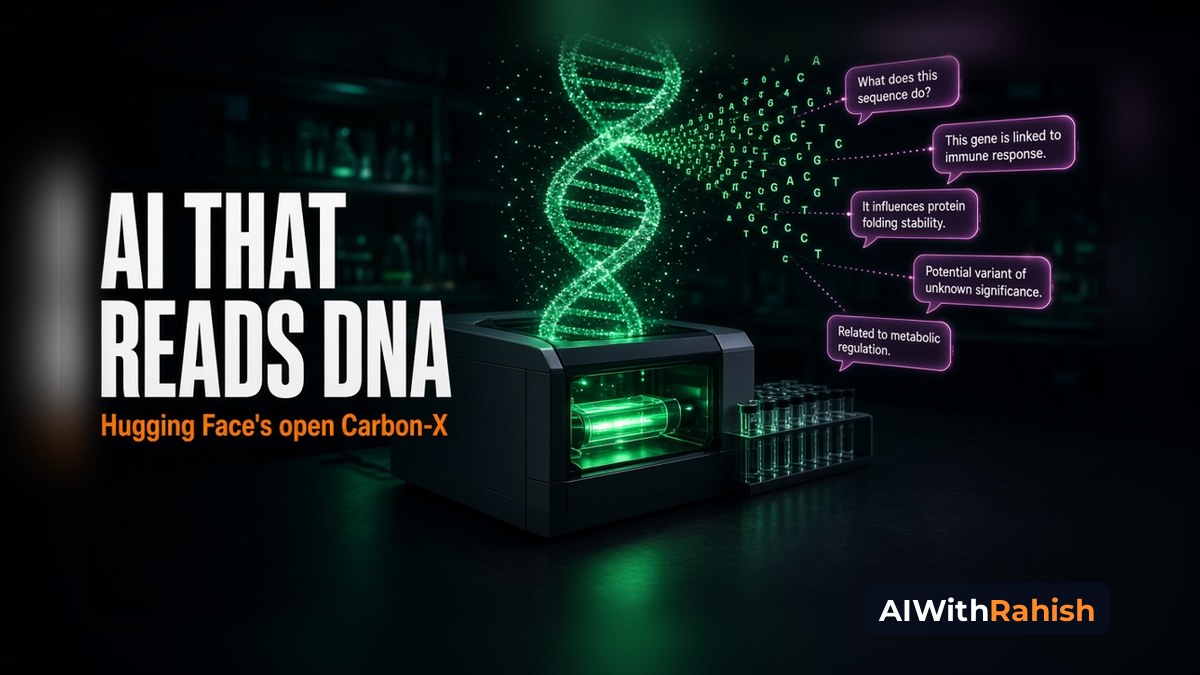
Hugging Face Bio has released Carbon-X, an open 14.8-billion-parameter DNA language model, documented in its Hugging Face model card. The weights are a joint effort by research teams at Hugging Face, Zhongguancun Academy, and the Telethon Institute of Genetics and Medicine / University of Naples “Federico II”. MarkTechPost covered the launch on October 25, 2026. Unlike pipelines that bolt a separate DNA encoder onto a text model, Carbon-X treats DNA and English as one token stream inside a single decoder—you paste raw sequence into an ordinary chat and get answers in English about mutations, regulatory regions, organism groups, and next-base prediction, with reasoning in the reply.
What Carbon-X is
Carbon-X belongs to Hugging Face's Carbon model family. It is a decoder-only causal language model that starts from Qwen3-14B, extended with thousands of DNA-specific vocabulary entries. The architecture matches a modern text LLM: 40 layers, hidden size 5120, grouped-query attention with 40 query heads and 8 KV heads, SwiGLU activations, and RMSNorm with QK-norm. Total vocabulary size is 157,184 tokens—mostly the Qwen3 BPE set plus 5,515 DNA tokens.
The model ships under Apache 2.0 on the Hub as HuggingFaceBio/Carbon-X, with a release Space and optional GGUF weights. Hugging Face also documents a carbon-dna skill for Claude Code and Codex CLI so coding agents can call a locally served Carbon-X instance. The card is explicit that Carbon-X is not clinically validated and should not be used to make medical decisions.
How DNA and text share one tokenizer
The hybrid tokenizer keeps BPE for natural language and encodes canonical DNA as non-overlapping 6-mers—one token covers six base pairs. Runs of at least six A/C/G/T bases are auto-wrapped in DNA markers when you paste into a prompt; the model can emit DNA inside the same markers in its responses. Sequences whose length is not a multiple of six use dedicated tail tokens for the last one to five bases, and decoding returns the original sequence exactly.
There is no separate DNA encoder: attention runs over the mixed stream. Local runtimes need care: the official Carbon-X-GGUF files require llama.cpp b11742 or newer, the first release with support for Carbon's DNA tokenizer, and older builds load them but tokenize DNA wrongly; the main model card's agent section still says llama.cpp and other GGUF runtimes are not supported. For local inference, the card recommends Transformers v5+ with trust_remote_code=True or vLLM on a single GPU. Carbon-X was post-trained and evaluated with thinking disabled (enable_thinking=False), and Hugging Face recommends keeping that setting.
Training stack
Vocabulary extension starts from Qwen3-14B with randomly initialised DNA embeddings, then 302 billion tokens of mid-training (mix dominated by 55% raw DNA and 20% English), supervised fine-tuning on variant and sequence tasks, and GRPO reinforcement learning with verifiable rewards. Benchmark splits were decontaminated from training data.
Benchmark results
On five DNA benchmarks—with thinking disabled and one sample per problem—Carbon-X averages 66.7%, which the model card reports as 27 points above Qwen3-14B, ahead of every other open model they evaluated, and close to GPT-6.1 Sol (67.5%) at about 1/1,800 of the inference cost per problem (all self-reported, using each comparison model at the reasoning effort where it scored highest). It leads all models tested on BioReason Coding (74.9%) and NextBase (39.4%) in their table.
| Benchmark | Task | Carbon-X (self-reported) |
|---|---|---|
| BioReason Coding | Coding variant effects | 74.9% |
| BioReason Non-SNV | Complex variant effects | 85.1% |
| GenomeQA | DNA understanding (six subtasks) | 63.6% |
| NextBase | Next-base prediction | 39.4% |
| FrontierVEP | Single-base variant effects | 70.4% |
| Average | 66.7% |
On GenomeQA subtasks, the card reports 93.2% organism-group accuracy but only 29.8% splice sites and 34.6% histone marks. IFEval prompt-level strict accuracy is 79.3%.
Cost, context, and hardware
Carbon-X advertises a 40,960-token context window, though mid-training used 8,192-token sequences and post-training examples stayed under 16k tokens; the authors note limited evaluation on inputs much longer than training. Weights in bfloat16 fit on one 80 GB GPU, which matters for researchers who need to keep sensitive or unpublished sequences on their own infrastructure instead of sending them to a cloud API.
On economics, the model card estimates that analysing ClinVar's 2.4 million variants of uncertain significance would cost about $300 with Carbon-X versus $32,000 to $4 million with the frontier models they benchmarked—again their own arithmetic from measured throughput per H200-hour at $5/hour for Carbon-X versus standard API pricing for closed models. Carbon-X answers directly without extended reasoning chains, so output token volume stays comparatively small.
Limitations, privacy, and GGUF caveats
Besides the no-medical-use warning, the card stresses that genetic data is highly sensitive and that providers may handle inputs differently depending on how you run the model. Failure modes include base miscounts, coordinate errors, and hallucinated annotations when context is thin; long DNA generation is not a strength. Pair the model with code for exact operations and pass sequences by reference in agent setups.
Why it matters
Carbon-X is a rare open, chat-native DNA LM that still fits one 80 GB GPU—useful when API cost or data residency blocks sending raw sequence to GPT-6.1 Sol-class services. It does not replace validated clinical variant pipelines, but it gives researchers a reproducible baseline for mutation questions, regulatory-region prompts, and agent tool-calling experiments under Apache 2.0.
Sources
- Hugging Face: HuggingFaceBio/Carbon-X — Oct. 23, 2026
- Hugging Face: Carbon-X: When Natural Language Meets DNA — Oct. 22, 2026
- Hugging Face: HuggingFaceBio/Carbon-X-GGUF — Oct. 22, 2026
- MarkTechPost: Hugging Face Releases Carbon-X, a 14B Open DNA Language Model that Brings DNA and Natural Language Together for the First Time — Oct. 25, 2026