AI Industry
OpenAI Agents Mined Millions of Brain Cells in 32 Minutes
Oct 22, 2026·4 min read·By Rahish Saifi
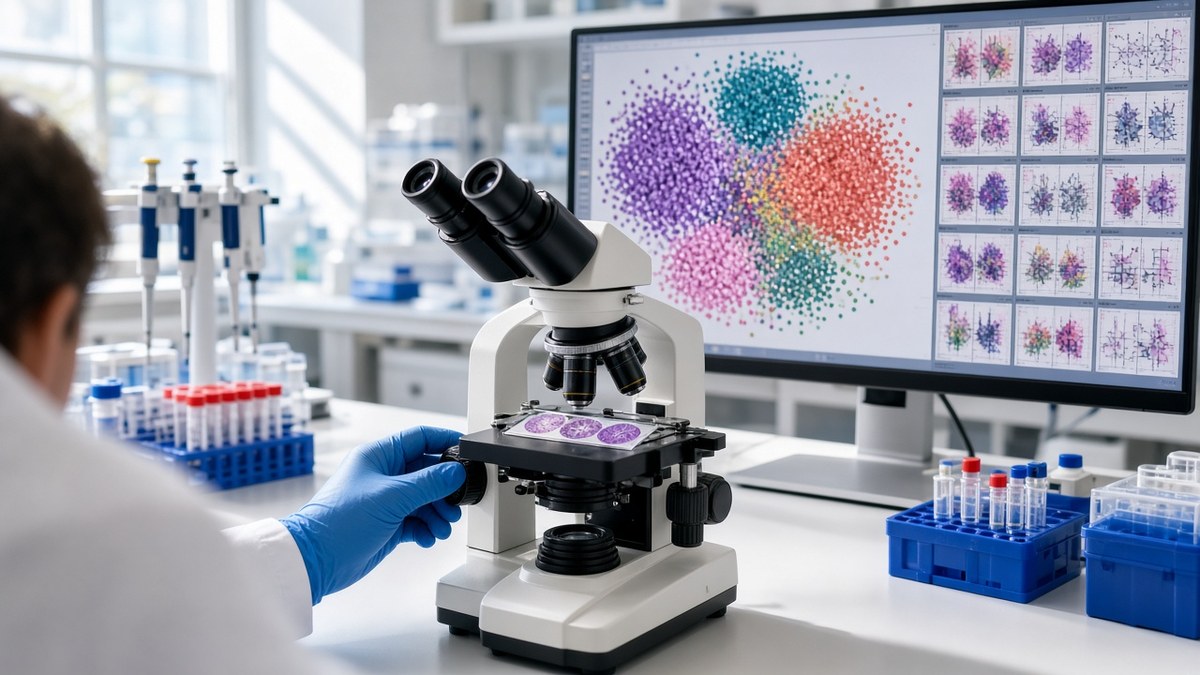
On October 21, 2026, OpenAI, biotech firm PerturbAI, and Scripps Research described a run in which thousands of AI agents powered by GPT‑Rosalind interpreted an existing whole-brain CRISPR atlas built from millions of mouse brain cells—finishing in 32 minutes. The team calls the approach distributed biological reasoning: one agent per gene disruption, each weaving together cellular readouts and literature into evidence-linked reports that were merged into a public reasoning atlas. Nothing here is a clinic-ready therapy; the output is a ranked set of research leads and hypotheses for labs to test next, grounded in mouse data that may or may not translate to people.
Key facts
| Item | Detail |
|---|---|
| Announcement | Oct. 21, 2026 — OpenAI blog, PerturbAI press release, and a bioRxiv preprint with Scripps Research |
| Data | Existing whole-brain in vivo CRISPR Perturb-seq atlas from mouse brain tissue (millions of cells; PerturbAI's public dataset) |
| Agents | Thousands of parallel agents on GPT‑Rosalind (preprint: 1,946 agents, one per perturbation) |
| Runtime | 32 minutes for 1,946 parallel agents to analyze the atlas and synthesize evidence-linked findings |
| Human baseline (estimate) | Comparable serial human analysis and literature review: months to a year (OpenAI; illustrative, not a timed trial) |
| Literature depth | At largest workload tested: distributed agents cited 700+ references vs 11 for a single agent on the same model and resources |
| Expert preference | Blinded human experts preferred distributed-agent reports over single-agent reports 75% of the time |
| Public output | Reasoning atlas linking genes, cell effects, papers, and proposed mechanisms — browse the hosted corpus |
What happened
Perturbation screens can now knock out thousands of genes across millions of cells, but connecting those readouts to disease biology and literature still bottlenecks on expert time. In OpenAI's Oct. 21 post, the team applied agents to PerturbAI's existing whole-brain CRISPR atlas from mouse tissue—each agent handled one gene disruption, analyzed cellular responses, searched papers, and proposed explanations. Reports were merged into a reasoning atlas you can browse now, alongside data on Hugging Face and the UCSC cell browser.
How distributed biological reasoning works
The architecture assigns one GPT‑Rosalind agent per perturbation, each with analytics tools and literature access, then synthesizes evidence-linked narratives across the screen. OpenAI calls that distributed biological reasoning: parallelism so every knockout gets depth, plus a merge step for study-wide maps. The preprint benchmarks recovery of source-atlas findings, held-out prediction, and blinded expert rankings—withheld from agents during the run. When workload grew, a single agent cited only 11 references versus 700+ for distributed agents on the same model and resources, illustrating how literature coverage collapses when one agent must carry an entire screen.
What the agents surfaced
OpenAI highlights two disease-adjacent leads—both explicitly framed as hypotheses for follow-up experiments, not proven mechanisms or treatments.
Tsc1 vs Tsc2 in the cerebellum. Both regulate mTOR and looked similar in several neuronal groups, but in the cerebellum, Tsc2 disruption altered dozens of neuronal-communication genes while Tsc1 disruption did little. That may connect to tuberous sclerosis, where cerebellum abnormalities track TSC2 mutations; agents flagged specific neurons and expression shifts to test—which changes existing mTOR medicines might fix and which might point to new research directions. These are hypotheses, not treatment claims.
DCTN1, cholesterol, and neurodegeneration. DCTN1 mutations cause Perry syndrome (Parkinson-like neurodegeneration). Disrupting Dctn1 in the mouse atlas raised cholesterol-synthesis genes; agents tied that to literature on transport stress driving compensatory cholesterol production—a possible link between intracellular cholesterol distribution and degeneration that human experts called novel and worth follow-up experiments.
“We build cell atlases so that other scientists can make discoveries we haven't imagined yet. AI could help more researchers explore these resources and turn unexpected observations into new questions to test.”
— Sarah Teichmann, Ph.D., Chair in Stem Cell Medicine at the University of Cambridge and founding co-chair of the Human Cell Atlas
“Sometimes the clues are already there, scattered across different fields—we just haven't connected them. The possible link between neuronal function and cholesterol metabolism shows how those pieces, once brought together, can give us a new way to think about disease biology.”
— Tomasz Nowakowski, Ph.D., associate professor of neurological surgery at UCSF
Why it matters
The demo is less about a single bigger model than orchestration: thousands of narrow GPT‑Rosalind investigations plus synthesis over a real perturbation matrix. PerturbAI and OpenAI will now apply the framework to PerturbAI's proprietary in vivo data to discover new drug targets; OpenAI stresses that scientists remain central—agents expand what gets read, humans still judge causality and design experiments. If replication holds, partly interpreted atlases could get a second, literature-heavy pass at scale.
Caveats
All cellular data are from mouse brains; human biology may differ. Findings are in a bioRxiv preprint, not peer-reviewed journals. The preprint's authors include OpenAI and PerturbAI employees, and two are PerturbAI co-founders. Agent write-ups are research leads—plausible stories that can still be wrong until tested. The months-to-year human timeline is an illustrative estimate for serial expert review, not a controlled race. The public hosted atlas exposes findings and evidence; recomputing statistics requires the raw data and open pipeline locally.
Bottom line
In 32 minutes, distributed agents traversed millions of mouse brain-cell measurements, cited 700+ papers where a lone agent managed 11, and were preferred over single-agent reports in blinded expert comparisons 75% of the time—while surfacing cerebellum and cholesterol-linked questions worth lab tests. Use the reasoning atlas as a map of hypotheses, not a shortcut to cures.
Sources
- OpenAI: Using thousands of AI agents to uncover new leads in biological data — Oct. 21, 2026
- bioRxiv preprint: Distributed AI agents enable comprehensive discovery of biological insights at scale — Oct. 16, 2026
- PerturbAI: PerturbAI and OpenAI Unveil First-of-Its-Kind AI Reasoning Agents to Scale Biomedical Discovery — Oct. 21, 2026
- OpenAI: Introducing GPT‑Rosalind for life sciences research — Apr. 16, 2026 (updated Sept. 11, 2026)
- Hosted reasoning atlas (Distributed Agents corpus)
- GitHub: jinlabneurogenomics/distributed_agent