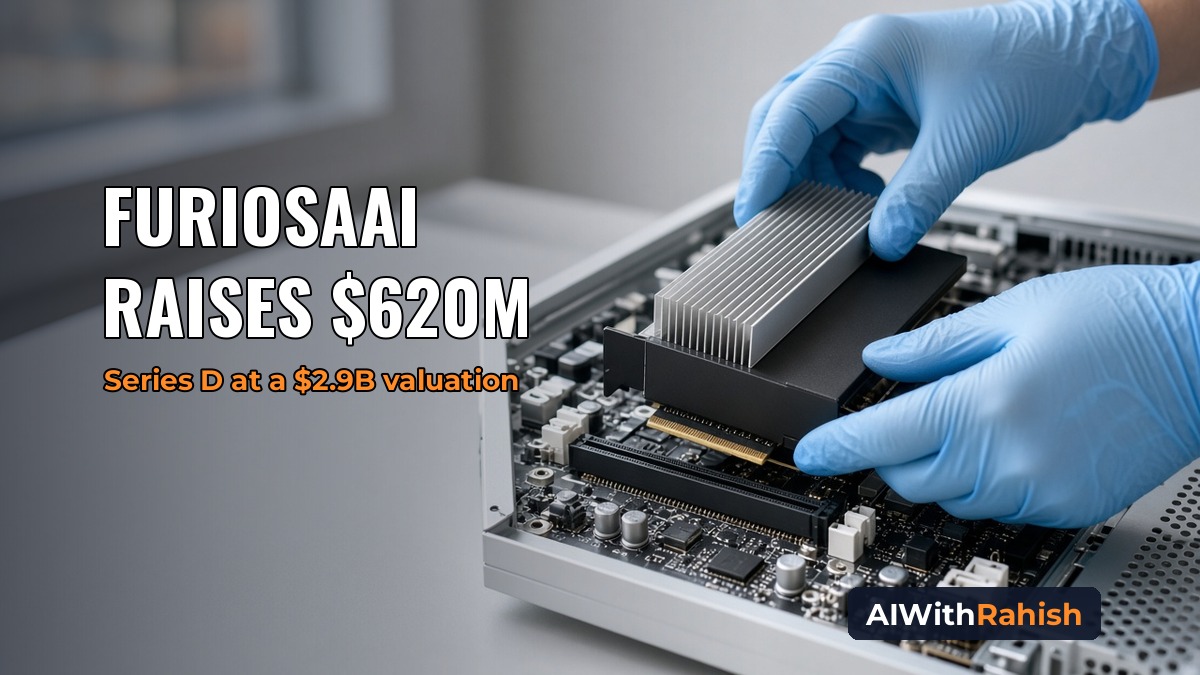
On October 28, 2026, Seoul-based FuriosaAI said it completed a $620 million Series D (about KRW 820 billion) at a post-money valuation of approximately $2.9 billion, according to its company blog and a Business Wire release. The round mixes international capital with Korean public and institutional backers as Furiosa scales its RNGD inference accelerators and funds a next-generation chip program with Broadcom and other partners. Furiosa, founded in 2017, has spent nearly a decade on custom AI silicon in a market that still treats Nvidia GPUs as the default answer for every workload.
Bloomberg Law reported that the valuation roughly quadrupled from Furiosa's prior round—language Bloomberg attributed to people familiar with the deal, not figures in the company's own announcement. Korean outlets translate the same won totals into slightly different dollar amounts because of exchange-rate timing; this article uses Furiosa's stated $620M and $2.9B headline numbers unless a source is explicitly cited.
Key facts
| Item | Detail |
|---|---|
| Round | $620M Series D (~KRW 820B); completed Oct. 28, 2026 (Furiosa / Business Wire) |
| Post-money valuation | ~$2.9B (company) |
| International capital | $110M total; Infinitum largest U.S. investor; also Jericho Capital, QUDA Capital Partners, Cisco Investments, NeoFort Holding, Worldline Capital (company) |
| Korean / sovereign | National Growth Fund of Korea and Korean institutions alongside the round (company); SiliconANGLE cites ~$280M from the fund; Seoul Economic Daily reports 370 billion won from the National Growth Fund |
| Existing shareholders | 170 billion won follow-on per Seoul Economic Daily / MoneyToday—reportedly including Korea Development Bank, NAVER, DSC Investment, KDB Capital, and Kakao Investment |
| Product | RNGD inference accelerator on Tensor Contraction Processor (TCP) architecture; mass production since Jan. 2026 |
| Scale targets | 20,000 RNGD cards in 2026; more than 40,000 in 2027 (company) |
| Use of proceeds | Scale RNGD production and deployments; strengthen software; Gen 3 silicon with Broadcom—2nm multi-die design with HBM4/4E for frontier agentic models in large clusters (company) |
| Founded | 2017, Seoul (company) |
Who put money in—and how Korea split the cap table
Furiosa's release emphasizes that international investors contributed $110 million of the round, with U.S.-based Infinitum as the largest international backer. It also names Jericho Capital, Singapore's QUDA Capital Partners (whose founder Charlie Foo is a former NVIDIA executive and now a principal advisor to Furiosa, per the release), Cisco Investments, Abu Dhabi's NeoFort Holding, and Worldline Capital. The financing ran alongside the National Growth Fund of Korea and other Korean institutions—reflecting both export credibility and domestic industrial policy around AI silicon.
SiliconANGLE reported that the National Growth Fund contributed about $280 million, while Seoul Economic Daily put the sovereign slice at 370 billion won. Those figures should be read as press reporting on the same tranche, not duplicate checks from Furiosa's short-form announcement. Seoul Economic Daily and MoneyToday also described 170 billion won in follow-on investment from existing shareholders including Korea Development Bank, NAVER, DSC Investment, KDB Capital, and Kakao Investment, and said the company had initially targeted a raise between 450 and 750 billion won. MoneyToday, citing market sources, reported a 3 trillion won pre-money valuation and called the deal the largest investment ever secured by a Korean startup—a superlative attributed to that outlet, not repeated in the Business Wire text.
RNGD: inference silicon built for watts, not training bragging rights
Furiosa positions RNGD as an inference-first accelerator built on its Tensor Contraction Processor architecture—hardware tuned for the matrix contractions that dominate transformer inference rather than the sprawling parallelism of frontier training clusters. The company says RNGD entered mass production in January 2026 as a 180-watt air-cooled PCIe card, a deliberate choice for data centers where rack power and cooling budgets are the binding constraint on how many users each kilowatt can serve.
Eight RNGD cards form the NXT RNGD Server: a 4U box drawing about 3 kW, delivering roughly 4 petaFLOPS of FP8 compute and 384 GB of HBM3, according to Furiosa's materials. The company claims RNGD matches RTX PRO 6000 throughput at the same card count and can serve twice as many users per kilowatt—marketing comparisons that should be treated as Furiosa's own benchmarks until independent tests are published, but that nonetheless spell out the pitch: sell inference density where GPUs are power-hungry and expensive to keep fed.
Production plans are aggressive: Furiosa targets 20,000 RNGD cards in 2026 and more than 40,000 in 2027. That volume matters because alternative silicon wins only when supply, software stacks, and cloud or enterprise distribution keep pace with Nvidia's CUDA gravity.
Customers already on RNGD
The release cites live deployments, not slide-deck pilots. LG Group runs its EXAONE models on RNGD; Upstage uses the accelerators for live search summarization; and Samsung SDS launched an NPU-as-a-service offering on RNGD in July, according to Furiosa. Those names anchor the story in Korean enterprise AI, where hyperscale labs are not the only buyers—conglomerates and IT services firms need on-prem or sovereign inference with predictable power draw.
For developers watching the market, the pattern rhymes with other 2026 funding stories: specialized inference silicon plus software and go-to-market, not another training-GPU clone. Furiosa's next step is to prove RNGD economics at tens of thousands of cards while keeping model support broad enough that EXAONE-scale workloads do not stall on compiler gaps.
Gen 3 with Broadcom—and why inference efficiency keeps attracting capital
Proceeds will scale RNGD manufacturing and field deployments, expand Furiosa's software stack, and fund a Gen 3 roadmap developed with Broadcom and additional partners. The company describes a 2nm multi-die design paired with HBM4/4E memory, aimed at frontier agentic models running in large clusters—language that signals ambition beyond today's single-server RNGD boxes even as the near-term revenue likely stays PCIe and 4U form factors.
SiliconANGLE framed the round as a bet that data-center power bottlenecks, not raw FLOPs alone, will decide who captures enterprise inference spend as models move from demos to always-on agents. That is the same macro story behind U.S. neoclouds and alternative chip startups, but Furiosa's Korean cap table and sovereign fund participation make it a national-scale manufacturing bet as well.
Why it matters
2026's infrastructure narrative keeps splitting: hyperscalers lock in Nvidia training clusters, while a parallel market optimizes inference latency, throughput per watt, and deployability on non-GPU silicon. A $620 million Series D at roughly $2.9 billion post-money is a vote that inference-specific accelerators can still raise growth-stage capital even as public markets punish generic GPU neoclouds.
For teams shipping agents and search copilots, the practical question is whether RNGD-class hardware can slot into existing PCIe fleets without rewriting every kernel—and whether Furiosa's software can keep pace with model churn. The company's customer list suggests early enterprise traction; the Gen 3 roadmap with Broadcom suggests it does not intend to stay a single-generation niche vendor.
What's next
Furiosa will need to hit its stated 20,000-card 2026 and 40,000-plus 2027 shipment targets while expanding beyond Korean anchor tenants. Gen 3 bring-up on 2nm multi-die silicon is a multi-year program; until then, RNGD density and air-cooled power envelopes are the proof points investors and customers will watch. See also General Compute Raises $100M for Ultra-Fast AI Inference and Jim Keller's Tenstorrent Raises $1.5B at a $6.2B Valuation for two other 2026 stories about inference economics and alternative AI silicon.
Sources
- FuriosaAI: FuriosaAI closes $620 million Series D to scale efficient, production-ready AI inference — Oct. 28, 2026
- Business Wire: FuriosaAI Secures $620 Million Series D to Meet Surging Enterprise AI Inference Demand and Accelerate Next-Gen Silicon — Oct. 28, 2026
- SiliconANGLE: Energy-efficient inference chip developer FuriosaAI raises $620M to solve the data center power bottleneck — Oct. 28, 2026
- Bloomberg Law: FuriosaAI Quadruples Value to $2.9 Billion in Nvidia Chase — Oct. 28, 2026
- Seoul Economic Daily: FuriosaAI Raises 820 Billion Won at 3.8 Trillion Won Valuation — Oct. 29, 2026