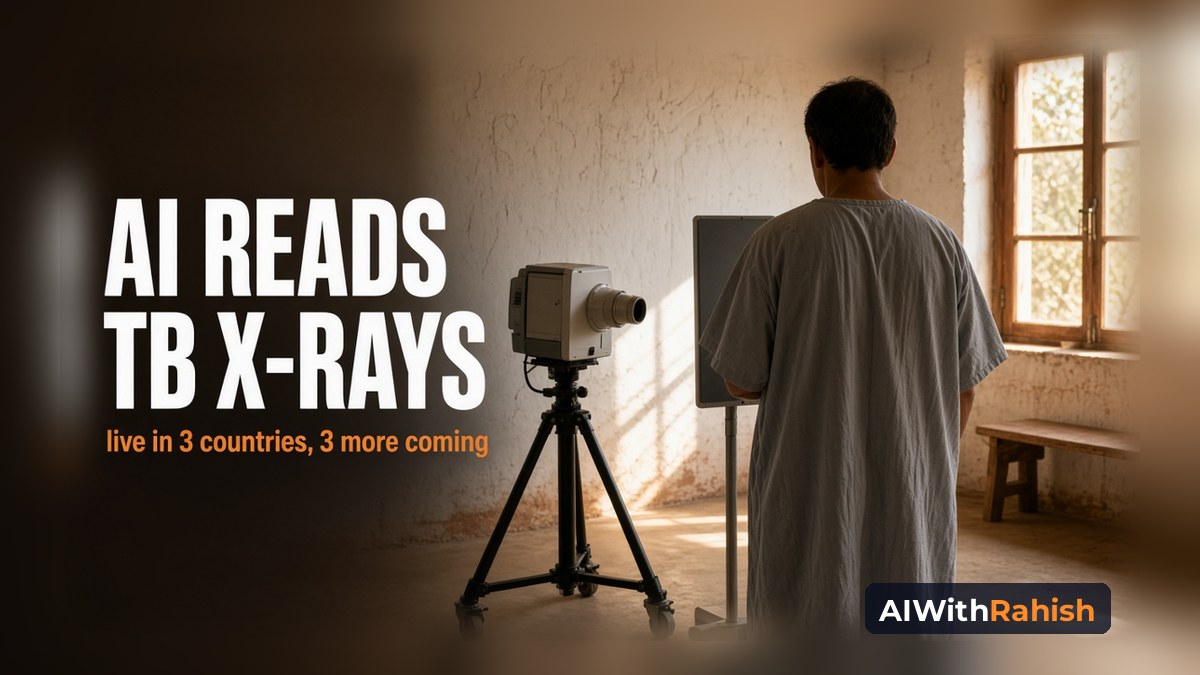
In an October 23, 2026 Google Research post, Preeti Singh and Shravya Shetty describe how years of Google health AI research are moving from papers and benchmarks into clinics that screen for tuberculosis (TB). The team shared the update at IDWeek 2026 in Washington, D.C. TB remains one of the world's deadliest infectious diseases, killing an estimated 1.23 million people a year; Google argues that in high-burden settings, scarce radiologists and distant imaging infrastructure leave millions of active cases undetected.
From Radiology benchmarks to bedside tools
Google's work began by asking whether AI could read chest radiographs (CXRs) for TB screening at expert radiologist accuracy—a hard task because subtle signs demand specialists rural clinics lack. A 2019 Radiology paper showed deep learning matching experienced radiologists; August 2021 Lancet Digital Health Stop TB Partnership testing ranked Google's model among the top CAD algorithms globally (the year WHO recommended CAD for TB triage); and a September 2024 NEJM AI prospective study reported high sensitivity across diverse sites plus incidental pulmonary and cardiac findings.
Google describes a “translation gap” before any algorithm becomes a bedside tool: varied X-ray hardware, offline operation, workflow integration, and medical device regulation.
Nexus AI certification and regulatory path
Google partnered with Pretoria-based Nexus AI to translate its chest X-ray algorithms into a certified tool. Nexus AI holds CE MDR Class IIb certification under EU MDR 2017/745 and ISO 13485 quality management compliance. It signed with FIND to pursue WHO Pre-qualification (WHO PQ) for global procurement and is on an ongoing pathway toward U.S. FDA clearance—not cleared yet. The device screens CXRs for lung diseases including TB in as little as 45 seconds.
Three countries live, three more underway
Google writes that Nexus Intelligence is bringing the technology where diagnostic access is most urgent. Nexus AI's tool is live in three countries—South Africa, Sierra Leone, and Côte d'Ivoire—with expansions underway in the Democratic Republic of the Congo, Zambia, and Cameroon, operating in approximately 40 healthcare facilities across those rollouts. More than 90 clinicians have evaluated more than 25,000 chest radiographs, cutting turnaround from weeks to under 45 seconds while clinicians retain the final decision.
Nexus AI has delivered more than 3,000 free screenings to under-resourced public clinics and is progressing toward a goal of 10,000 sponsored screenings annually. Google emphasizes that the AI accelerates triage while empowering clinicians to make final clinical decisions—speed without replacing human judgment at the bedside.
Four kilometers underground at Mponeng
One deployment Google highlights is the Mponeng Gold Mine in South Africa, among the deepest mines in the world. Deep-shaft miners face silica dust exposure and elevated pulmonary disease risk. With the Stop TB Partnership, Harmony Gold Mine, and the South African Department of Health, Nexus AI deployed ultra-portable digital X-ray kits and offline AI four kilometers underground. Miners are screened on-site within seconds; those flagged with presumptive TB can be referred immediately for confirmatory molecular testing. Screening, triage, and confirmatory testing can occur in a single visit—a pathway that often takes weeks.
Open models: HAI-DEF, MedSigLIP, and MedGemma
Through Health AI Developer Foundations (HAI-DEF), Google open-sourced chest X-ray embeddings and MedSigLIP for image–text medical tasks, plus MedGemma open-weight 4B and 27B multimodal models (overview) that reason over images and clinical text locally offline. MedGemma has passed 10 million downloads since launch.
Indonesia's national scale and HeAR cough screening
For sovereign deployment, Google points to Indonesia's Ministry of Health, which faces the world's second-highest TB burden and aims to screen 50 million citizens annually. Reviewing that volume manually is infeasible, and proprietary cloud software raises data residency concerns. The Ministry is fine-tuning MedGemma and MedSigLIP on domestic chest radiographs; because models run on local infrastructure, patient data stays within national borders.
Where imaging cannot reach every remote post, Google Research developed Health Acoustic Representations (HeAR), trained on more than 300 million audio segments for cough-based acoustic screening via a smartphone microphone. HeAR research spans sub-Saharan Africa with CIDRZ (Zambia), the Aurum Institute (Ghana)—supported by a $250,000 Google.org grant—and HELINA's $1.5 million regional collaborative. Together, acoustic triage (HeAR), portable X-ray AI (HAI-DEF), and multimodal reasoning (MedGemma) form the integrated diagnostic cascade Google describes for underserved populations.
What's still missing
WHO PQ is still being pursued via FIND, and FDA clearance is not granted. The post's deployment metrics—clinics live, radiographs read, sub-45-second turnaround, sponsored screenings—report throughput, not patient-outcome endpoints. Local partners are expanding live rollouts and cough-triage evidence while Google supplies open models and research support.