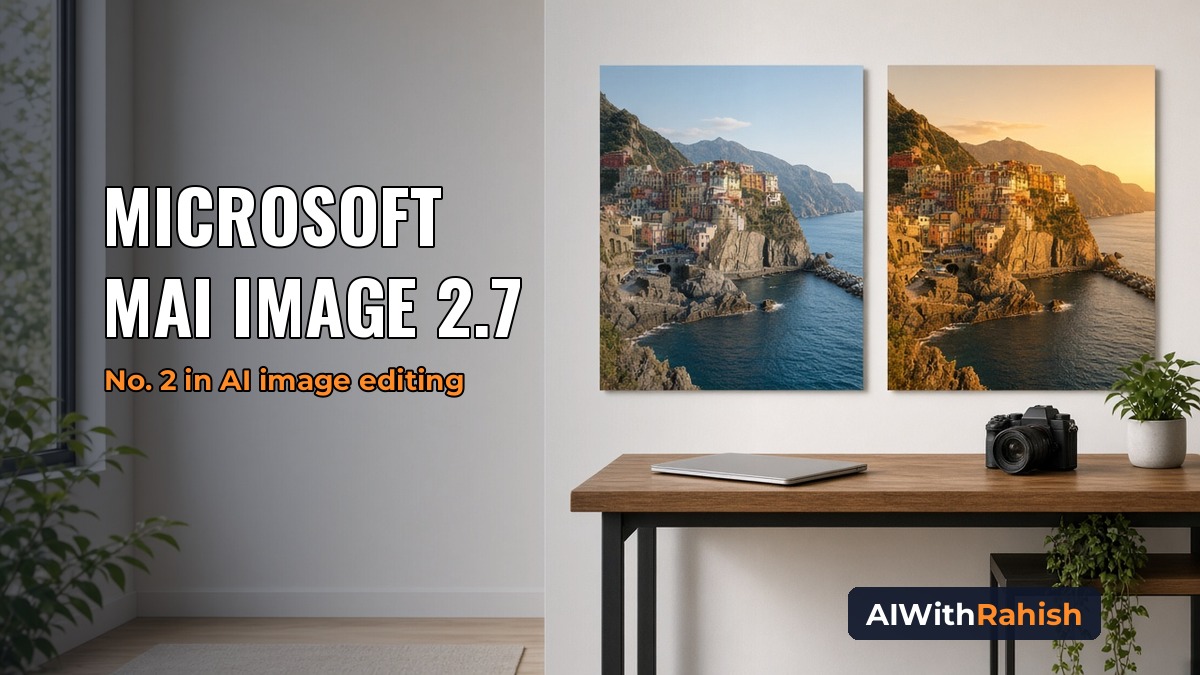
On October 27, 2026, Microsoft AI announced MAI Image 2.7 (MAI-Image-2.7-Preview), its latest in-house model tuned for precision image editing rather than fresh text-to-image generation. In a Microsoft AI news post, the company said the preview launches at No. 3 on Arena Edit—making Microsoft AI the No. 2 lab on that board—and at No. 2 on Artificial Analysis's image editing leaderboard, ahead of OpenAI's GPT Image 2.5 Flare on that chart. Coverage from Neowin adds concrete Elo scores and notes what is still missing on the product side.
What Microsoft launched
Microsoft positions MAI Image 2.7 as a step up in control over hard edits: relighting or restyling whole scenes, changing text and symbols while keeping them visually integrated, restoring or enhancing existing assets, and applying changes that require the model to understand how objects, lighting, and environments fit together. The Oct. 27 post frames those capabilities as everyday creative work—moving a product into a new setting, shifting mood and lighting, or reworking individual objects without breaking the wider composition.
Neowin emphasizes that this preview release is editing-first. Microsoft said text-to-image generation support is coming soon, but the initial public drop is about changing pixels in an existing image, not minting new ones from a prompt alone. That is a different emphasis from Microsoft's earlier MAI-Image-2.6 line, which Neowin recalls debuted at No. 2 on Arena's text-to-image leaderboard in August (behind OpenAI's GPT-Image-2) and was followed in September by MAI-Image-2.6-Flash, a faster, cheaper variant aimed at high-volume generation.
What the model is built to do
Microsoft says great editing boils down to control over the details that matter. Its announcement lists four areas where MAI-Image-2.7 reaches what it calls the category frontier on Artificial Analysis benchmarks: enhancement and restoration, reasoning-based edits, scene and style, and text or symbol editing.
In practical terms, that covers improving quality and restoring visual detail in an existing photo; edits that need the model to reason about objects and their surroundings; changing appearance, lighting, and mood while keeping the image coherent; and modifying words or symbols so they still look natural in context. Neowin repeats the same four buckets and notes Microsoft's claim that the model improves over MAI-Image-2.6 across all 10 use cases and seven editing actions that Artificial Analysis evaluates—without naming each benchmark individually in either primary or secondary source.
Microsoft highlights scene and style as the stand-out category: there, it says MAI-Image-2.7 scores 24 Elo ahead of the next-best model. That margin is attributed to Microsoft's own announcement; Neowin does not repeat the 24-point scene-and-style gap, so treat it as Microsoft-reported unless another leaderboard publish confirms it.
Leaderboard numbers and how to read them
Rankings on both Arena Edit and Artificial Analysis come from blind human preference evaluations, Neowin notes—not automated scores alone. That matters when comparing labs: a higher Elo reflects more users picking one edit over another in head-to-head tests, not a single numeric quality metric on a fixed test set.
On Artificial Analysis's image editing leaderboard, Neowin reports these Elo figures for the preview:
| Model | Elo (per Neowin) |
|---|---|
| GPT Image 2.5 Sunburst | 1,199 (leader) |
| MAI-Image-2.7 Preview | 1,193 (No. 2) |
| GPT Image 2.5 Flare | 1,182 |
| MAI-Image-2.6 (prior Microsoft model) | 1,151 |
Neowin describes that gap as a 42 Elo improvement from MAI-Image-2.6 to the new preview. Microsoft's post does not list those integers; it states ordinal ranks—that the preview is No. 2 on Artificial Analysis and No. 3 on Arena Edit, with Microsoft AI as the No. 2 lab on Arena—and that the model debuts above GPT Image 2.5 Flare on Artificial Analysis. Neowin also places the preview at No. 3 on Arena's image editing leaderboard, aligning with Microsoft on Arena placement while supplying the numeric Elo table only for Artificial Analysis.
Where you can try it—and what is not announced yet
Microsoft says MAI-Image-2.7 Preview is available for image editing through MAI Playground, Arena, and Artificial Analysis. Those channels let curious users and benchmark contributors exercise the model in the same ecosystems where the leaderboard results are collected.
What is missing, according to Neowin, is any word on pricing or Microsoft Foundry availability for developers. The preview is positioned as a public try-it-now editing model in playground and benchmark venues, not yet as a billed API SKU. Until Microsoft publishes Foundry or Azure AI Foundry terms, teams building production pipelines should assume no enterprise contract path for this specific preview.
Text-to-image is explicitly coming soon in Microsoft's post; Neowin repeats that timeline. If Microsoft ships generation on the same weights family, the MAI Image line could again span both creation and edit—but Oct. 27 messaging is edit-only.
Why it matters—and how it compares to MAI-Image-2.6
For designers and marketing teams, a No. 2 editing rank on a major preference leaderboard signals that Microsoft's in-house vision stack is competitive with OpenAI's latest image line on mutating content, not just generating it. Relight passes, localized object swaps, and in-image text fixes are the sort of tasks that show up in ad variants and catalog refreshes; Microsoft is arguing its preview handles those with fewer destructive side effects.
Relative to MAI-Image-2.6, the story is breadth plus a standout scene-and-style win. Microsoft claims uniform gains across Artificial Analysis's full use-case and action matrix, while Neowin quantifies the overall lift as 42 Elo on that leaderboard. The earlier 2.6 generation still matters historically—it put Microsoft on Arena's text-to-image podium—but 2.7 Preview shifts the narrative toward edit fidelity and reasoning-heavy changes.
For the wider market, the split between Sunburst (still ahead on Neowin's Elo table), Microsoft's preview, and Flare shows image editing as a three-way race at the top, with human judges rather than a single vendor self-report deciding order. Microsoft AI being the second-ranked lab on Arena Edit also underscores that the company is investing in consumer-facing creative models alongside its enterprise Copilot stack—not only in foundation text models.
Until API pricing lands, the near-term impact is experimentation: creatives can stress-test relights and restorations in MAI Playground, researchers can compare outputs on Artificial Analysis, and competitors can see exactly where 24 Elo of scene-and-style margin claims to sit—while remembering that Sunburst still leads Neowin's cited Elo table and that Foundry access remains unannounced.