AI Industry
NVIDIA DSX POD Cuts AI Factory Deployment to 14 Days
Oct 22, 2026·4 min read·By Rahish Saifi
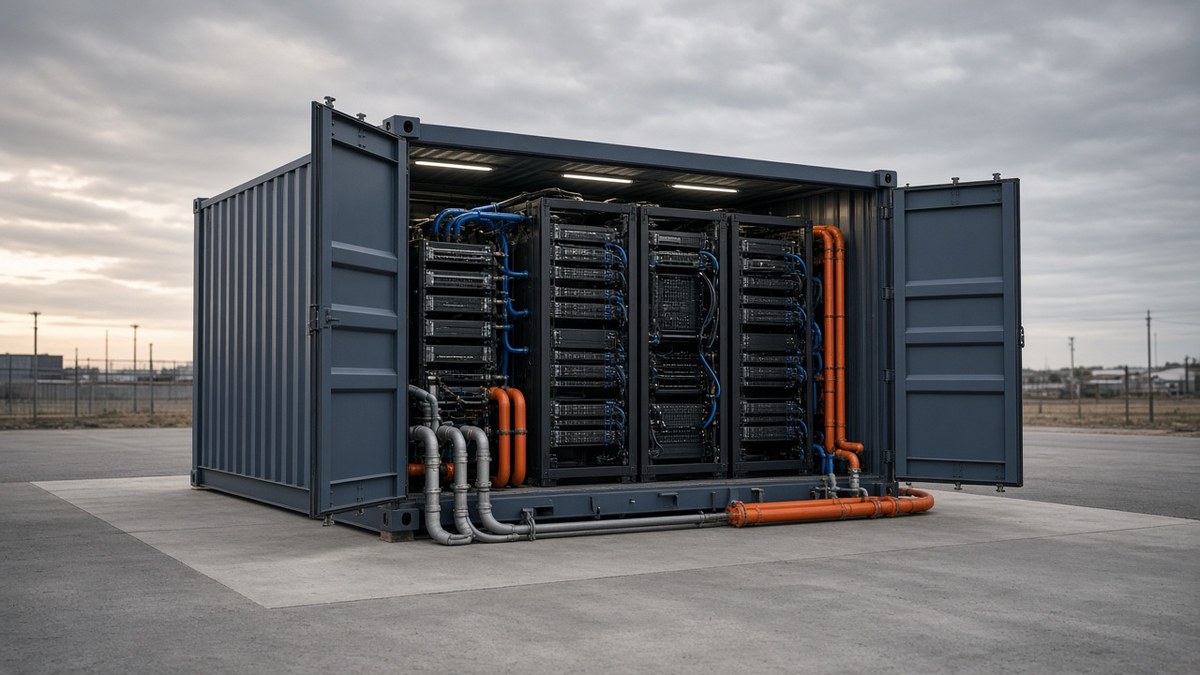
NVIDIA at GTC Berlin on October 21, 2026 unveiled DSX POD, a reference design for complete NVIDIA Vera Rubin AI factories that ecosystem partners build inside modular containers, integrate, and validate at the manufacturing facility before shipment. The pitch is not a faster ribbon-cutting ceremony—it is shrinking the gap between pouring concrete and serving production inference when power and land, not silicon orders, often cap how fast Europe and other regions can add capacity.
Key facts
| Item | Detail |
|---|---|
| Announcement | October 21, 2026 — NVIDIA press release, technical blog, product page, and GTC Berlin keynote coverage |
| What it is | Reference design for complete Vera Rubin AI factories built in modular containers, factory-integrated and validated before delivery |
| Deployment speed | At a prepared site, deployment time falls from six months to as little as 14 days |
| Factory integration | Compute, networking, cabling, rack-level power, and liquid cooling assembled and tested at the partner facility; rack-to-rack cabling, wiring, piping, and functional validation before shipment |
| Power interface | 800 VDC standard input at the container boundary (NVIDIA technical blog) |
| Cooling | Internal liquid-cooling loop flushed and pressure-tested at the factory; site connects to prepared water and heat rejection |
| Partners | Anduril, Armada, Bull, Crusoe, DayOne, Dell Technologies, Delta, Eaton, Foxconn (Ingrasys), GIGABYTE, HPE, Lenovo, Pegatron, QCT, Schneider Electric, Vertiv, Wistron |
| Availability | Worldwide deliveries targeted for early 2027 |
| Not mandatory | Conventional data center builds and onsite-integrated designs remain supported options (technical blog) |
Why time to first token matters
An AI factory only earns when it is running models for customers—not when the last rack door closes. NVIDIA's press release frames time to first token as the moment new capacity starts serving production workloads and generating revenue. In power- and site-limited buildouts, especially across Europe, long onsite integration schedules can leave GPUs idle while teams chase cabling, cooling leaks, and incremental cluster tests.
CEO Jensen Huang put it this way in the release: “An AI factory creates value when it starts producing tokens — not when construction is complete.” DSX POD is meant to move repeatable integration upstream so operators spend fewer months in the field and more time billing inference.
What ships inside a pod
DSX POD extends the broader NVIDIA DSX infrastructure platform with a container-first architecture. Partners do not drop loose racks on a slab; they deliver a unit that already bundles Vera Rubin rack-scale compute with the networking, storage, power distribution, controls, and liquid cooling needed to operate as one system.
NVIDIA's technical blog describes factory validation across rack inventory, firmware baselines, power-on checks, fabric connectivity, sensors, cooling integrity, and system-level functional tests—treating the installed environment as a deployment unit rather than a pile of independent shipments. Networking and storage are part of the reference design, with defined connectivity inside and between containers and trunk paths to the customer's external network.
What still happens on site
Containerization does not erase civil work. Site teams still prepare land, foundations, utility interfaces, and external power, cooling, and networking while containers are built in parallel. After delivery, crews place units, complete inter-container connections, hook up external power and cooling, confirm transport integrity, and commission the full loop.
The technical blog is explicit: DSX POD changes where integration happens, not whether a facility exists. Heat rejection, regional electrical codes, and grid-specific upstream conversion stay with partners who engineer the path from utility to the standardized 800 VDC container input.
Who builds and delivers them
NVIDIA supplies the validated reference design; the ecosystem manufactures and installs it. OEMs and ODMs integrate compute, mechanical and electrical specialists adapt power and cooling, modular providers build enclosures, and site partners handle installation and commissioning—with regional engineering and support throughout.
The October 21 partner list spans defense and neocloud operators (Anduril, Armada, Crusoe, DayOne), European and global systems vendors (Bull, Dell Technologies, HPE, Lenovo), ODMs (Foxconn/Ingrasys, GIGABYTE, Pegatron, QCT, Wistron), and infrastructure names (Delta, Eaton, Schneider Electric, Vertiv). Deliveries worldwide are planned for early 2027.
What it means for neoclouds and enterprises
For neoclouds racing to turn contracted power into sellable GPU hours, a repeatable factory-built unit can reduce schedule risk from specialized onsite labor and late-stage integration bugs. Enterprises with land and utility entitlements but thin bench strength for rack-scale liquid cooling get a path where partners shoulder most of the mechanical and network assembly.
Standardized container interfaces also give operators a defined expansion block: add capacity with the same validation playbook instead of re-deriving cabling and cooling for every phase. NVIDIA notes that when the underlying compute, network, power, and telemetry layout is known, software and operations can be tuned for that environment—without claiming containers are the only way to build.
What is not known yet
NVIDIA's public materials do not publish pod pricing, per-container rack counts, or customer-specific configuration menus. Those details will likely emerge as partners productize implementations. Until then, the measurable promise in the release is schedule: months of onsite work compressed toward a two-week hookup window at a site that is already prepared—and revenue tied to tokens, not construction milestones.
Sources
- NVIDIA Newsroom: NVIDIA Introduces DSX POD AI Factories to Accelerate Europe's Infrastructure Deployment — Oct. 21, 2026
- NVIDIA Technical Blog: Achieve Productive AI Capacity Faster and More Predictably with NVIDIA DSX POD — Oct. 21, 2026
- NVIDIA: DSX POD Reference Design for AI Factory Infrastructure
- NVIDIA Blog: GTC Berlin 2026: Live Updates From NVIDIA CEO Jensen Huang's Keynote — Oct. 21, 2026