LLMs
OpenAI Adds Visual ChatGPT Ads as Weekly Users Hit 1.2 Billion
Oct 6, 2026·4 min read·By Rahish Saifi
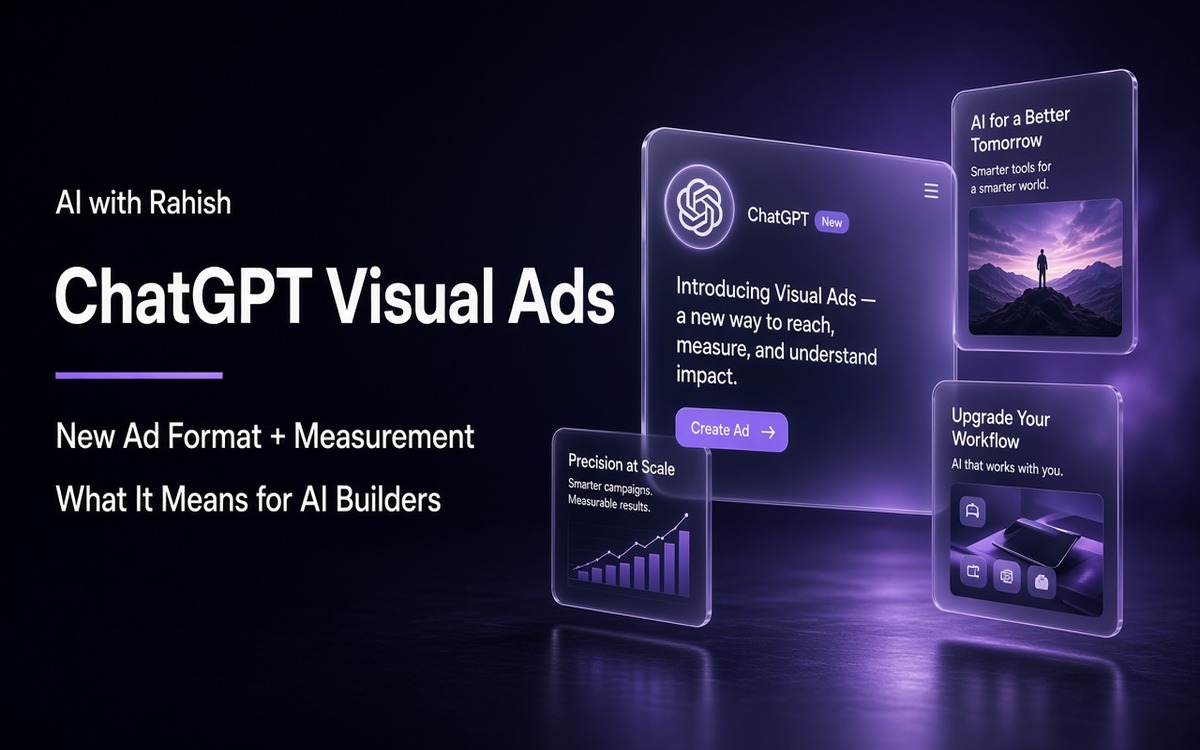
On October 5, 2026, OpenAI published Building advertising for the way people use AI, outlining a new visual ad format in ChatGPT, broader measurement integrations, and early brand suitability work with independent vendors. The post frames advertising as a way to fund broad access: OpenAI says ChatGPT reaches 1.2 billion people each week, calling it the world’s largest AI-native consumer platform.
For builders and product leaders, the announcement is less about creative templates and more about how a conversational surface monetizes without contaminating model outputs—a design constraint every agent product will face as usage scales.
What OpenAI announced
The headline product change is a visual ad format meant to help people discover products and services through images—product inspiration, usage scenarios, or experiences ads enable. OpenAI says ads will be clearly labeled and kept separate from image generation output when testing begins during image generation in ChatGPT.
Importantly, the company repeats a line from its ads principles: advertising does not influence the answers ChatGPT provides. Testing is scheduled to begin later in October 2026 in the United States with an initial group of advertisers.
Measurement and attribution expand
OpenAI’s measurement story is partner-heavy. The post lists integrations intended to connect advertiser conversion data to ChatGPT Ads:
- Data pipeline partners: Hightouch, Tealium, and LiveRamp.
- Attribution and reporting across web and app: AppsFlyer, Triple Whale, Adjust, DV Rockerbox, Northbeam, Branch, Singular, Kochava, Airbridge, and Tenjin, plus fuller-funnel partners such as Fospha, Measured, and INCRMNTAL.
- Incrementality experiments with Haus, Measured, and WorkMagic using geo-based tests—described as early-stage.
OpenAI cites early partner-reported results, including DV Rockerbox’s note that WeightWatchers’ attributed cost per acquisition on ChatGPT Ads was 15.3% lower than its blended paid-search benchmark, WorkMagic’s statistically significant lift for wellness brand Dose (67% of incremental purchases from net-new customers), and Triple Whale’s figure that 93% of Portland Leather visitors from ChatGPT Ads were new.
Those figures come from partners, not independent audits—but they signal how marketers will judge the channel: incremental reach and efficiency versus search and social, not click-through vanity metrics alone.
Brand safety in a conversation-native medium
Context in ChatGPT is defined by the thread, not a publisher URL. OpenAI describes placement guardrails that assess whether a conversation is appropriate for ads, aiming to keep ads out of emotionally vulnerable, sensitive, or otherwise unsuitable contexts.
For advertisers with narrow placement rules, Negative Phrases are now available to qualifying brands. OpenAI also announced suitability evaluation pilots with DoubleVerify and Integral Ad Science (IAS), emphasizing that partners assess safeguards in controlled testing without accessing private user conversations.
CEO quotes from IAS and DoubleVerify in the post underscore the industry’s concern: as ads move into AI-native environments, marketers need durable, scalable brand-safety assurances—and users need privacy preserved.
What this means for AI product teams
Separate “answer quality” from “adjacent monetization”
If you ship a copilot with sponsored suggestions, users will ask whether recommendations changed the model’s reasoning. OpenAI’s public commitment—that answers stay independent—is the minimum trust bar. Architecturally, that implies hard separation between retrieval/ranking for ads and the core completion path, with logging that proves the boundary in audits.
Expect measurement to be multi-vendor
Enterprise buyers already standardize on Tealium, LiveRamp, or AppsFlyer stacks. ChatGPT Ads is meeting them where their data lives rather than inventing a walled garden metric. If you monetize an agent, plan for Conversions API-style integrations early; otherwise marketing teams cannot justify spend.
Conversation context is the new “page context”
Guardrails that score suitability per thread are closer to dynamic brand safety than static keyword blocklists. Product and policy teams should document which conversation classes are ad-eligible and how appeals work when a false positive blocks revenue.
Bottom line
OpenAI’s October 5 update is a scaling play: visual formats for discovery, measurement rails for performance marketers, and third-party suitability pilots for brand trust—all while insisting ChatGPT’s answers remain ad-independent. Whether that balance holds at billion-user scale will be tested in public; for now, the engineering lesson is clear: monetize adjacent surfaces, not the reasoning core.
Consumer apps that add sponsorship should copy the labeling pattern OpenAI promises—ads visibly distinct from generated media—and publish measurement methodology so regulators and users can audit claims. The 1.2 billion weekly user figure sets expectations: even small policy mistakes will become front-page news.