On Nov. 3, 2026, OpenAI published “Accelerating engineering for the physical world,” outlining how its models support engineers who build real hardware. The post opens with a line OpenAI uses verbatim: “Today, we’re sharing advances in how OpenAI models help engineers design, simulate, and build physical products.” Capabilities span mechanical and electrical engineering and end-to-end system design. The write-up names a new research tie-up with Mazda, expands work with Chip Ganassi Racing, and describes an internal device test with GPT-6 Astra. For related coverage, see GPT-6 Astra Ultrafast Promises Up to 8× Faster Tokens on NVIDIA Blackwell.
Key facts
| Item | Detail |
|---|---|
| Announced | Nov. 3, 2026 |
| By | OpenAI |
| New partner | Mazda (aerodynamics and crash-safety research) |
| Expanded | Chip Ganassi Racing |
| Model named | GPT-6 Astra |
| Hardware-team token usage | up 23-fold since February |
What OpenAI announced
OpenAI frames the post as a progress report on physical-world engineering rather than a single product launch. It highlights Codex and ChatGPT use inside its own hardware groups, BenchCAD 2.0, collaborations with racing and automotive partners, and an invitation for outside engineering firms to join through a web form. OpenAI is not publishing finished vehicle programs in this note; it says it will share more on the Mazda work in the coming months.
The Mazda collaboration
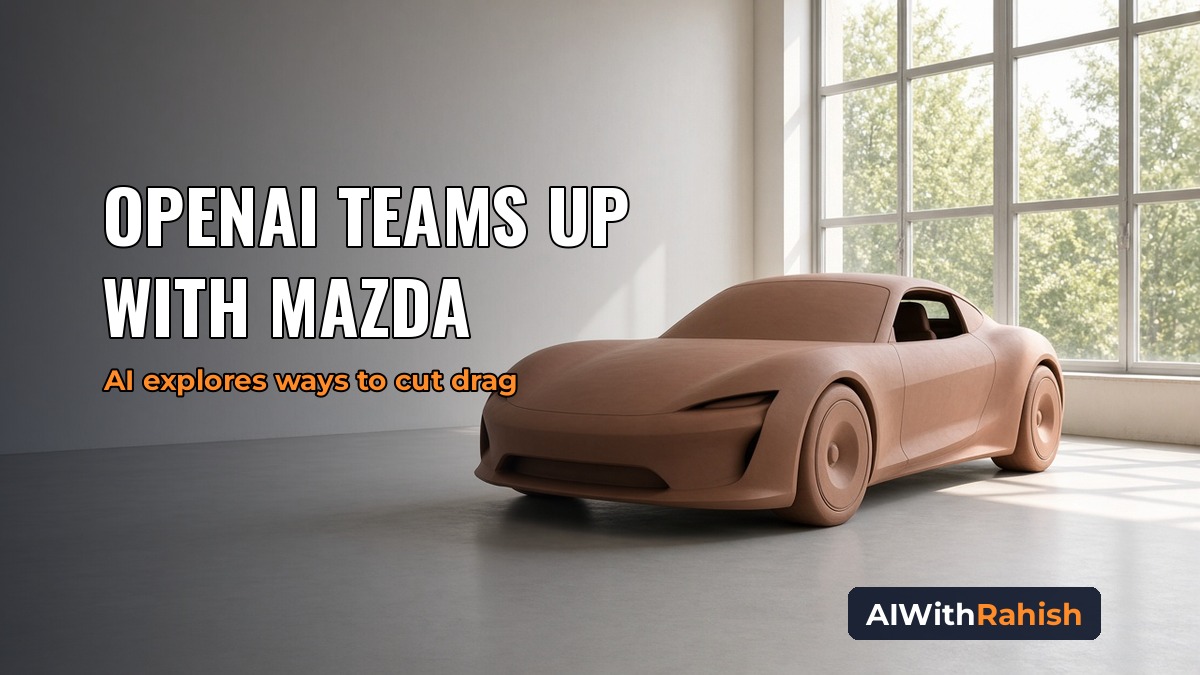
OpenAI writes, “We’re also announcing a new research collaboration with Mazda.” Its research and Forward Deployed Engineering teams are working with Mazda’s aerodynamics and crash-safety engineers to explore how models can help develop and evaluate new vehicle designs. The work uses simulations of airflow and structural behavior, OpenAI says, to explore improvements in performance while accounting for styling and cost.
GPT-6 Astra in Codex helps Mazda’s aerodynamics engineers explore ways to reduce vehicle drag by modeling new nose shapes, simulating airflow, and refining the most promising designs. Akihiro Nakata, principal engineer at Mazda, said in the post: “By exploring and simulating dozens of variations, Astra in Codex helps us understand which features matter for aerodynamics and where designers have room to explore.”
A device designed with Astra
OpenAI says it tested Astra in multimodal and computer use workflows by seeing if it can create a device without any direct human edits. It used GPT-6 to define functional requirements and design the enclosure, printed circuit board (PCB), and software integrations for a device users can use to talk to Codex. Astra developed the look, drawing on OpenAI’s Work Louder collaboration and references from games and toys, designed the enclosure and internal structures, selected electrical components and designed the PCB, and designed the UI and generated firmware and software integrations.
Two team members designed this test device with Astra in under a week while working on it as a side project. A contract manufacturer built a small batch of prototypes in under a month. OpenAI also states limits plainly: “Getting the device ready for manufacturing still required several rounds of review and iteration. Astra did not consistently account for the manufacturer’s production limits, tolerances, or details required for assembly.”
Inside OpenAI's hardware teams
OpenAI hardware teams use Codex and ChatGPT to create and revise CAD models, prepare manufacturing drawings, set up simulations, and review designs, across robotics and compute infrastructure. Grace Lam, forward deployed engineer at OpenAI, said: “Codex has dramatically accelerated how we move from an idea to an engineered part.” Since February, model usage across OpenAI hardware teams, measured in tokens, has grown 23-fold. That internal adoption story sits alongside broader interest in models that can steer real machines, a theme companies such as SAP have pursued with SAP Unveils Physical AI to Steer Warehouse Robots.
The BenchCAD 2.0 numbers
OpenAI describes BenchCAD 2.0 as a test of whether models can reconstruct 3D parts and assemblies and identify connections in circuit boards. On that benchmark, a newer internal model achieved an average score of 0.875, compared with 0.594 for GPT-6 Astra at its highest reasoning setting. OpenAI does not name the internal model in the post; the comparison is from OpenAI’s own evaluation setup.
Chip Ganassi Racing
OpenAI is expanding its collaboration with Chip Ganassi Racing (CGR). With CGR’s R&D team, OpenAI is testing workflows that turn 3D scans of existing parts into editable CAD models and 2D manufacturing drawings, particularly useful when the original design files are unavailable. CGR engineers review outputs for accuracy and manufacturability before anything reaches the track.
What it means
Analysis (ours). OpenAI is pitching GPT-6 Astra as an engineering copilot that spans CAD, boards, firmware, and simulation, while being candid that manufacturing still needs human iteration. The Mazda and CGR programs are research collaborations with engineer-in-the-loop review, not announcements of AI-designed cars heading to showrooms. BenchCAD scores and token-growth figures come from OpenAI’s own yardsticks. Watch whether OpenAI publishes third-party validation or Mazda-specific outcomes when it promises updates in the coming months.
What to watch
Follow-up posts from OpenAI on the Mazda aerodynamics work, broader adoption of the engineering collaboration form, and whether outside teams reproduce BenchCAD-style CAD reconstruction scores on their own parts libraries.