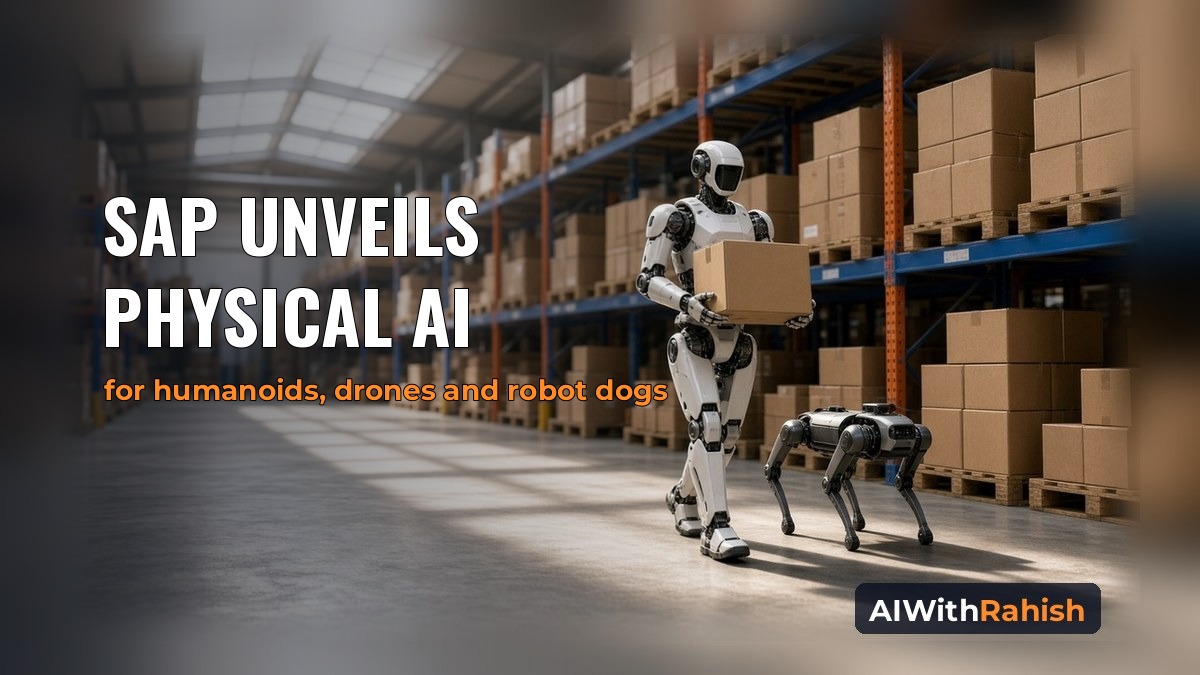
On October 27, 2026, at SAP TechEd, SAP unveiled physical AI that extends the Autonomous Enterprise into the physical world, according to SAP News Center. The announcement positions SAP's offering as business-driven physical execution: industrial robots, humanoids, sensors, robot dogs, and drones are linked directly to the SAP processes that run an organization, so enterprise knowledge triggers physical actions and outcomes return to SAP as structured, auditable data.
Closing the gap between the business system and the floor
SAP contrasts machine-centric physical AI with a model where businesses act: robots, humanoids, sensors, robot dogs, and drones tie directly to SAP processes. Field operations now produce rich signals on asset health, throughput, and exceptions, but SAP says a gap remains between enterprise knowledge and ground truth—delayed responses and physical work that never hits the business record. Its TechEd message is a single control loop: business context triggers action, signals return with context, and every physical step leaves a traceable SAP record.
Four pillars of physical AI by SAP
SAP framed the capability around four design pillars. Business-driven physical action grounds every execution in order priorities, safety rules, inventory status, and compliance so the business system—not an isolated robot controller—decides what runs, when, and why. Physical evidence into digital workflows means tasks leave audit trails and observations return to SAP automatically, turning field outcomes into inputs for the next decision. Enterprise-governed execution builds on the SAP Business AI Platform with traceability, auditability, and human-in-the-loop control, feeding SAP Business Data Cloud as structured data products. Finally, SAP positions the stack as vendor and hardware agnostic: customers pick devices and models while SAP supplies context, orchestration, and governance and partners supply physical execution.
Foxconn: warehouse tasks that humanoids understand
Foxconn is among the named collaborators. Dr. Wang, head of Physical AI at Foxconn, said in the SAP article that intelligent manufacturing needs physical systems that understand business context, not only motion commands. He said that with physical AI by SAP, warehouse tasks from SAP Extended Warehouse Management directly orchestrate Foxconn's humanoid robots and autonomous transport systems; asset inspections triggered by maintenance plans flow to robotic platforms and return verified outcomes to SAP.
Wang summarized the closed loop this way: "the robot knows why it acts, and the business system knows what happened."
Arçelik-LG, Intel, and Holcim use cases
Arçelik-LG, the Arçelik–LG Electronics joint venture that manufactures air conditioners, deploys a humanoid through SAP Extended Warehouse Management to execute and record inbound storage tasks. SAP credits the setup with tackling incorrect storage placements in inbound logistics and cites potential savings of millions of euros, with ecosystem partner FairConsult 24|7.
Intel operates a vast global warehousing network and serves as both proof-of-concept site and technology collaborator. SAP provides business context, workflow governance, and orchestration; Intel supplies the physical AI hardware and software foundation at the edge. Warehouse transport tasks generated in SAP become robot missions executed autonomously, with outcomes fed back into business systems. At Intel's Chengdu site in China, SAP and Intel demonstrated end-to-end material movement that reduces transport distances and repetitive manual handling (partner Anu Intelligence).
Holcim, the Swiss multinational in building materials and sustainable construction, turned to physical AI after the Embodied AI Jam in August 2026. On-site quadruped dogs inspect conveyor belts in dark, dusty areas and kiln status in extreme temperatures; drones cover assets at height humans cannot easily reach. In SAP Plant Maintenance, the maintenance plan triggers the inspection; once the drone or quadruped completes the action, SAP creates a maintenance notification. Partners: Cyberwave, Field AI, and Hybird.
Where customers can start
SAP said organizations can begin with warehouse operations and asset inspection use cases, or tailor a physical AI scenario to their requirements, as part of Industry AI. The article also points to broader themes—safety inspections and compliance—but does not announce product pricing or general-availability dates.
Why it matters (analysis)
For SAP-heavy enterprises, the strategic question is whether the ERP becomes the mission system for humanoids, AMRs, drones, and quadrupeds—not merely a downstream log. When transport and maintenance objects in SAP directly authorize motion, reconciliation between WMS, PM, and shop-floor reality could shrink materially.
The announced customers span contract manufacturing, consumer durables, semiconductor logistics, and heavy industry, which suggests SAP is selling an orchestration layer rather than a single robot SKU. Partners still own the metal and edge stack; SAP owns the business reason code. Adoption will likely be judged on closed-loop reliability and governance in harsh environments—Holcim kilns and Foxconn warehouses—more than on keynote demos alone.