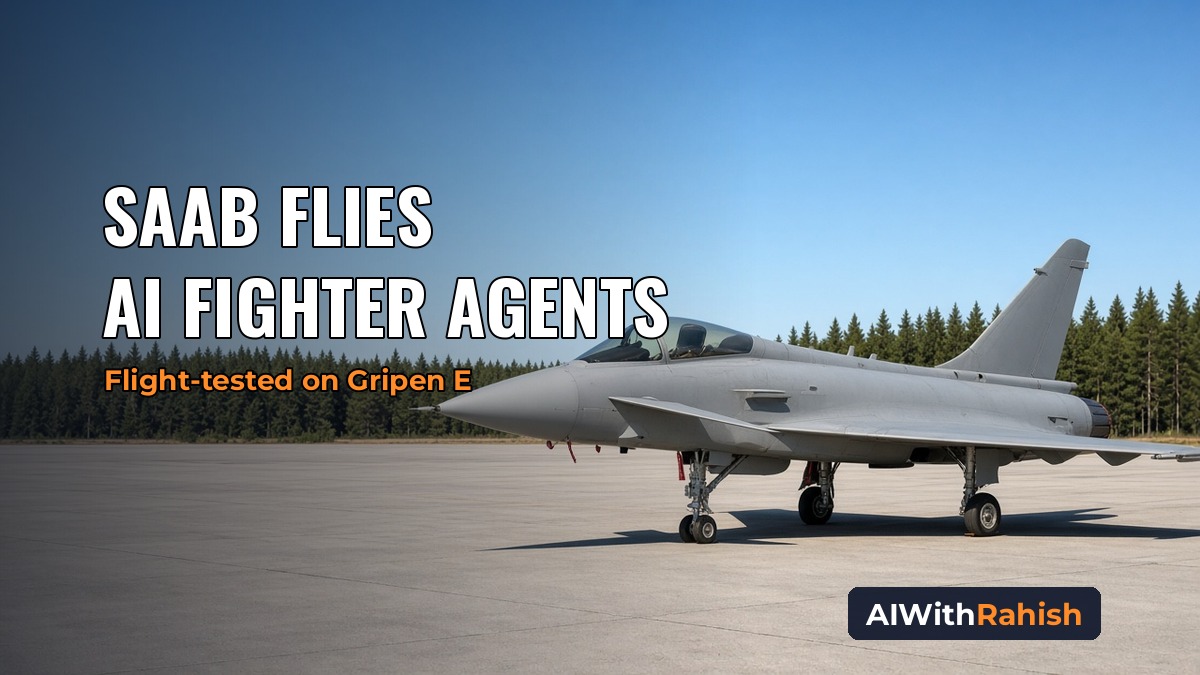
On Nov. 3, 2026, Saab said it is revealing its own in-house, flight-proven artificial intelligence agents and has flown them on Gripen E, taking its AI all the way from concept to an operational fighter aircraft.
Key facts
| Item | Detail |
|---|---|
| Announced | Nov. 3, 2026 |
| Company | Saab (Advanced Programs, Aeronautics) |
| Aircraft | Gripen E |
| Flight test | Agent autonomously controlled the jet in BVR combat scenarios |
| Training | AI Fighter Pilot Academy, millions of simulated flight hours |
| Compute partner | Sferical AI |
What Saab announced
Within Advanced Programs, Saab has built a family of AI agents that use various AI techniques for tactical decision-making in complex operational environments. The agents can support a pilot in the cockpit or operate alongside pilots on Saab's own unmanned air platform. Agents, training environments, and development tools were all developed within Saab, which says that gives full control over operation, verification, and evolution.
Peter Nilsson, head of Advanced Programs at Saab's business area Aeronautics, said in the release: “We have not only built our own AI agents, but we have also flown them. This demonstrates our capability to develop AI agents that can be integrated into operational fighter aircraft.”
What happened in the flight trials
During the flight trials, an agent autonomously controlled the aircraft in Beyond Visual Range (BVR) combat scenarios. Saab's release does not give dates, locations, or weapon details; it states that BVR air combat has now been validated under real flight conditions. That is flight-test validation, not a claim about live weapons or operational combat.
How the AI Fighter Pilot Academy trains agents
Saab's AI Fighter Pilot Academy develops agents while building infrastructure to create, train, and evaluate them across scenarios and platforms. Agents train in simulated environments, accumulating millions of simulated flight hours across operational scenarios and exploring tactics beyond what any individual pilot could experience in a lifetime, Saab says. Infrastructure is designed for reuse as new capabilities and platforms are added.
Why Gripen E's software-defined design matters
Gripen E's software-defined architecture enables new AI software to be integrated and flown on an operational fighter without dedicated experimental platforms, Saab says, shortening development cycles and moving new technology toward operational capability faster.
Safety, trust, and the sovereign compute behind it (Sferical AI)
Saab states that AI for fighter aircraft must be trusted, with safety and control integrated from the outset rather than added afterward. It is expanding agent capabilities and flying broader scenarios; academy infrastructure is an important foundation for unmanned platforms. Sferical AI, a Swedish sovereign AI initiative providing secure, large-scale computing capacity, supports the work; Saab is a founding partner.
What it means
Analysis (ours). Saab is pitching end-to-end ownership of fighter AI—agents, simulators, tooling, and flight test on Gripen E. Validating BVR agent control under real flight conditions goes beyond simulation-only announcements, even without public detail on envelopes or scenarios.
Industrial agent stacks show a parallel: vendors that own models, training, and deployment iterate faster, as with enterprise physical AI for robots (SAP Unveils Physical AI to Steer Warehouse Robots). Air combat raises the safety bar; Saab emphasizes trust integrated from the start.
What to watch
Additional flight-test detail, split roles between cockpit assistance and Saab's unmanned platform, and follow-on capabilities trained through the academy and Sferical AI-backed compute.