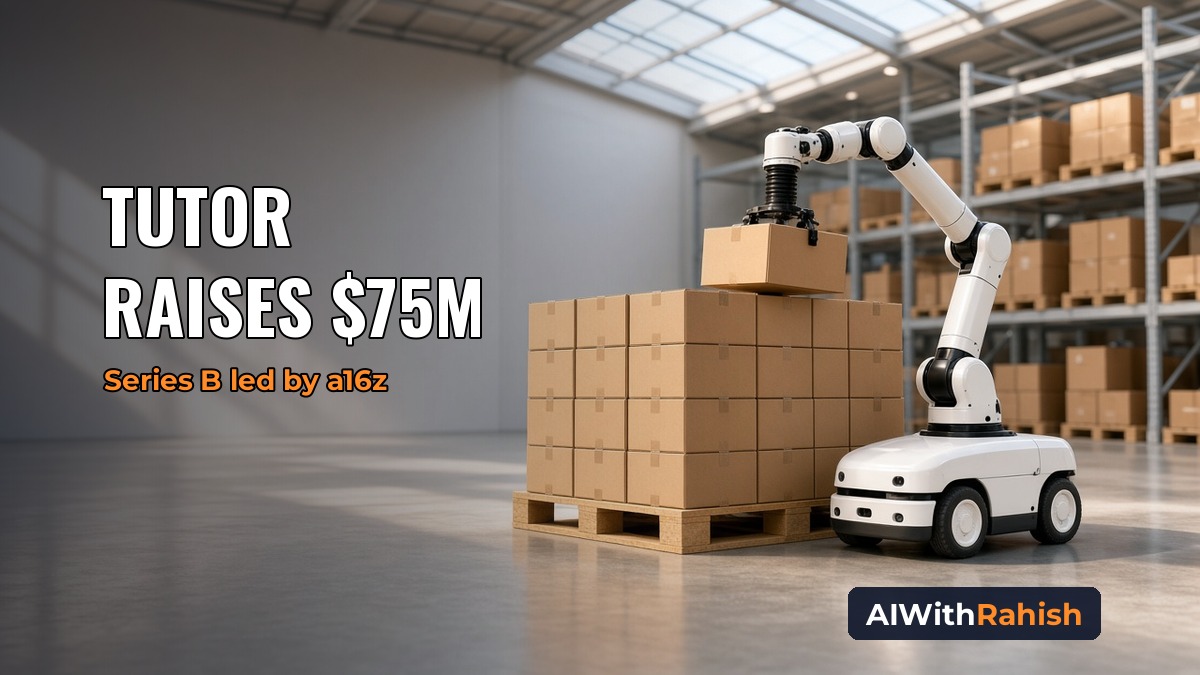
On Nov. 2, 2026, Watertown, Massachusetts-based Tutor Intelligence, a robotics research and deployment company, announced a $75 million Series B led by Andreessen Horowitz, bringing total capital raised to $117 million. The round funds frontier robot foundation model training plus manufacturing and deployment of its Sonny and Cassie robot workers across the United States. Valuation was not disclosed.
Key facts
| Item | Detail |
|---|---|
| Company | Tutor Intelligence; Watertown, Mass.; robotics research and deployment (MIT CSAIL roots per company reporting) |
| Round | $75M Series B; announced Nov. 2, 2026; total raised $117M |
| Lead investor | Andreessen Horowitz (Series B lead) |
| Other investors | Union Square Ventures (Series A lead); Neo (seed lead) also participated |
| Valuation | Not disclosed |
| Robot workers | Sonny (two-armed, each-pick, e-commerce fulfillment); Cassie (single-arm mobile manipulator for case picking and palletizing / de-palletizing) |
| Business model | Robot work sold by the hour or by the pick; no upfront purchase; no long-term contract; remote human tutors guide fleets; each task generates training data |
| Traction | Robots in almost four times as many facilities as a year ago; on track for more than 1,000 robots under contract by end of 2027, built and deployed in the US (company) |
| Expansion | Nearly a third of customers who received robots in the past 12 months were existing customers adding robots; implementation times as low as 8 hours (a16z) |
The deal
Tutor's Nov. 2 announcement, carried on Business Wire, says Andreessen Horowitz led the Series B and that Union Square Ventures and Neo, which led the Series A and seed rounds respectively, joined the round. Proceeds will support frontier robot foundation model training and the manufacturing and deployment of Sonny and Cassie, which run Tutor's own models in customer facilities. None of the primary sources in this set state a post-money valuation or revenue.
Who invested
| Round | Lead (as reported) |
|---|---|
| Series B (Nov. 2, 2026) | Andreessen Horowitz |
| Series A | Union Square Ventures |
| Seed | Neo |
Andreessen Horowitz's Nov. 2 post says it is leading the Series B because Tutor focuses on completing specific jobs repeatedly and accurately for customer after customer. The firm highlights Tutor's deployment-first path: real production environments, human tutors training models, and data collected from work that customers already pay for.
What Tutor does: Sonny, Cassie, and tutors
Tutor deploys internet-connected robot fleets into factories and warehouses. Remote operators called tutors guide the hardware while customers receive usable output; every completed task feeds real-world experience data back into Tutor's foundation models. The company describes its goal as closing the gap between what robots can do and what people can do.
Cassie uses a single arm for case picking and palletizing and de-palletizing workflows. Sonny adds a second arm and greater dexterity for each-pick work such as e-commerce fulfillment. Both embodiments share the same model stack, part of Tutor's vertical integration across brain, hardware, and data collection, according to Andreessen Horowitz.
Tutor says its robots operate across some of the country's largest manufacturing and logistics networks, handling goods such as breakfast cereals, snacks, candy, cosmetics, home goods, and toys.
Pricing and deployment
Tutor sells robot work the way businesses buy labor: by the hour or by the pick. Customers make no upfront purchase and sign no long-term contract; Tutor handles deployment, maintenance, and regular software and model updates. Andreessen Horowitz notes that hourly pricing shifts robotics from large upfront capex toward opex, opening mid-market manufacturers as well as major logistics operators.
The company reports robots working in almost four times as many facilities as a year ago and expects more than 1,000 robots under contract by the end of 2027, all built in and deployed from the United States. The Robot Report adds that twice as many Tutor robots are working in the field compared with a year ago alongside that facility expansion.
What wasn't disclosed
Valuation, revenue, and current fleet size were not disclosed in Tutor's Nov. 2 statement or in Andreessen Horowitz's announcement post. This article does not estimate any of those figures.
Why it matters
Analysis (ours). Warehouse and logistics automation often stalls on data and integration, not arm counts. Tutor's loop—paid deployments, tutor-guided operation, and model training from live picks—mirrors how LLM labs turned usage into improvement, but with pallets and totes instead of tokens.
A $75M Series B at $117M cumulative funding signals investor belief that the service model and US-built fleet can scale before full autonomy. Readers tracking physical AI in the enterprise should compare Tutor's hourly robotics pitch with data-centric peers such as GenRobot AI's $100M Series A+ for robot training data and deployment-heavy stacks like SAP Unveils Physical AI to Steer Warehouse Robots.
What to watch
Progress toward more than 1,000 robots under contract by 2027, repeat expansion rates among existing customers, published implementation timelines in new sites, and any future disclosure of valuation or fleet scale.
Sources
- Business Wire: Tutor Intelligence Raises $75 Million Series B Led by Andreessen Horowitz to Scale Frontier Robotics Model Training, Manufacturing and Deployment — Nov. 2, 2026
- Andreessen Horowitz: Investing in Tutor Intelligence — Nov. 2, 2026
- The Robot Report: Tutor Intelligence raises Series B to scale model training, robot deployments — Nov. 2, 2026
- The Next Web: Tutor Intelligence raises $75M from a16z to put robots to work by the hour — Nov. 2, 2026