AI Industry
Ex-OpenAI Science Chief's Warp Sciences Raises $215M
Oct 23, 2026·5 min read·By Rahish Saifi
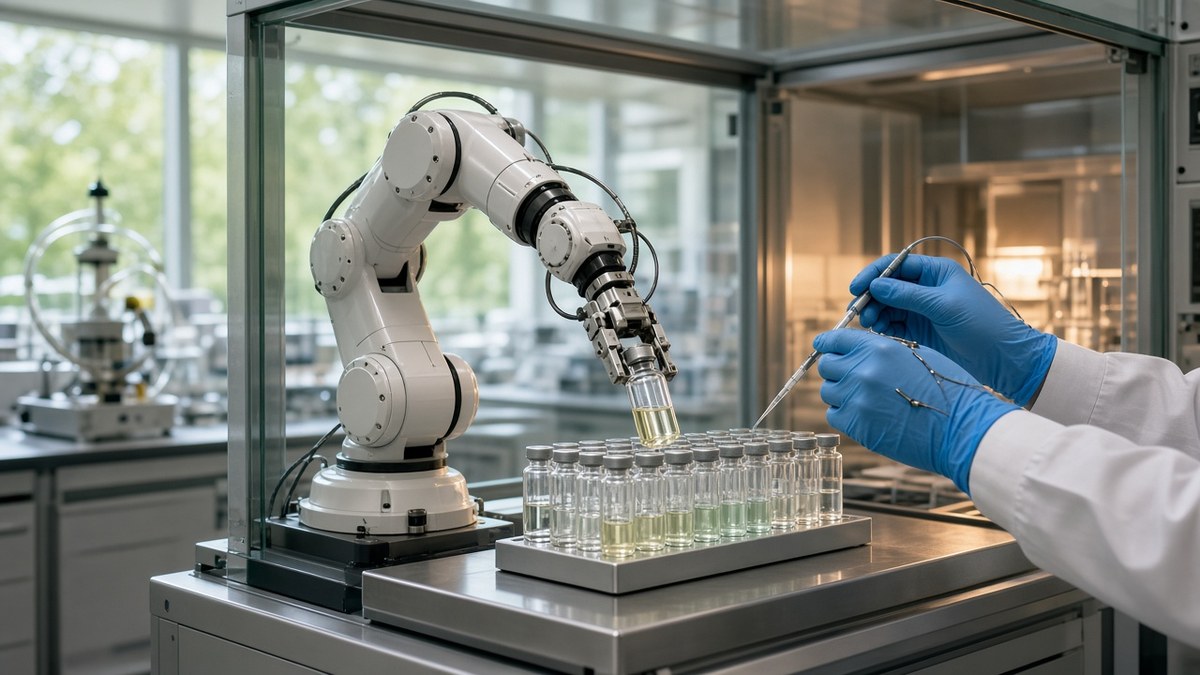
Warp Sciences on October 22, 2026 emerged from stealth with $215 million in funding to build a U.S.-based chemistry contract research organization that pairs expert chemists with AI and robotics. In its announcement, the company said the round was led by Lightspeed, with participation from Premji Invest, Mayfield, IVP, Lux, Conviction, Menlo Ventures, 01 Advisors, Standard, Lowercarbon Capital, Gigascale Capital, Angular Ventures, Scribble Ventures, Uncork Capital, Innovation Endeavors, Matter VP, Zero Shot Fund, SignalFire and Moxxie Ventures, among others. TechCrunch reported the financing at an $865 million valuation according to CEO Kevin Weil; the official release does not state a valuation figure.
Key facts
| Item | Detail |
|---|---|
| Round | $215M Series A; $865M valuation per TechCrunch, citing Weil (not in Business Wire release) |
| Lead investor | Lightspeed |
| Other investors | Premji Invest, Mayfield, IVP, Lux, Conviction, Menlo Ventures, 01 Advisors, Standard, Lowercarbon Capital, Gigascale Capital, Angular Ventures, Scribble Ventures, Uncork Capital, Innovation Endeavors, Matter VP, Zero Shot Fund, SignalFire, Moxxie Ventures (among others, per Business Wire) |
| What it does | U.S. chemistry CRO — makes and tests molecules for biotech and pharma; initial service is lead optimization analog synthesis |
| Model | No proprietary drug pipeline; customers retain control of programs (per release) |
| Founders | Kevin Weil (CEO), DJ Patil (COO), Solomon "Sol" Reisberg (CSO), Manohar "Mano" Paluri (CTO) |
| Announced | Oct 22, 2026 |
From browser to bench
The round is one of the clearest bets yet that frontier AI talent is moving from software into physical science labs. Weil was most recently Chief Product Officer and VP of Science at OpenAI; on X he framed the raise as "$215M Series A led by @lightspeedvp to bring frontier AI out of the browser and into the lab," adding that Warp is "not developing drugs of our own" but "building the infrastructure for the people who do"—language that matches the company's official positioning.
Lightspeed described Warp as building "robotic factories for chemistry, built in the US" and said it led the Series A. The firm lists Weil as CEO, Patil as COO, Reisberg as CSO (about 20 years in medicinal chemistry, five drugs into the clinic, with experience at Gilead and Schrödinger, per Lightspeed), and Paluri leading model and robotics work—consistent with his CTO title in the Business Wire release.
What Warp is building
Warp's ambition, as stated in the release, is to make discovery compound: experimental data helps train better AI, better AI powers more capable labs, and scientists gain capacity to test more ideas. The company is not selling a chat interface; it is operating as a chemistry services partner that synthesizes and tests the compounds research teams need.
Its initial service focuses on lead optimization analog synthesis—making variations of molecules scientists compare while searching for a drug candidate. Experienced chemists guide experiments as the lab is increasingly automated by AI and robotics, with AI models trained on data from physical experiments. Warp said its objective is to help customers discover drugs more efficiently and keep that discovery in the U.S.
TechCrunch reported that biotech has long outsourced molecule synthesis to contractors in China such as WuXi AppTec, and that Warp wants to reshore that work. The outlet said the startup's chemists will wear cameras and sensor gloves to train robots, and that robots could run around the clock—details not spelled out in the Business Wire text but attributed to TechCrunch's reporting.
Why geography and IP matter
The release cited a 2024 Biotechnology Innovation Organization survey in which 74% reported contracts with Chinese companies for preclinical and clinical services, according to Reuters—and noted the BIOSECURE Act, signed into law in December 2025, which established a framework for restrictions on federal procurement and funding involving designated biotechnology companies of concern.
CSO Reisberg said in the release: "I've worked with overseas chemistry partners that delivered speed and value, but I still worried about protecting the intellectual property behind our programs." Warp is positioning itself as a domestic partner with IP protection at the center of the relationship, without the price premium U.S. boutique CROs currently demand, per Reisberg. COO Patil stressed that customers determine which molecules to pursue and retain control of their programs.
The founding team and early hires
Beyond the four co-founders, Warp's release highlighted early hires with robotics experience from Genesis, Skild AI and 1X, and scientific expertise from Genentech and Lawrence Livermore National Labs. CTO Paluri said: "Our goal is simple: every experiment should make the next one smarter," and that Warp is building software, AI and robotics alongside the lab so each part is shaped by what chemists actually need.
Weil on data and the physical sciences
Weil's quote in the release captures the thesis investors are buying: "AI has dramatically accelerated software engineering and mathematics, but it has yet to make the same impact in the physical sciences," he said. "Chemistry and biology move forward when you make something, test it and learn from the result. If we want to build more capable AI for science, we need to generate real-world data at scale. Warp is starting that process by making the research compounds drug discovery needs today, while building the labs and automation to speed the cycle from hypothesis to experiment to answer."
Why it matters
Three threads converge in this round. Frontier-AI talent is moving into physical labs, not just model training. Data from real experiments is the bottleneck for scientific AI when the goal is reliable chemistry. And reshoring drug-discovery synthesis to the U.S. aligns with IP concerns and policy shifts Warp cites—including BIOSECURE-related scrutiny of overseas biotech services.
$215 million is a large Series A for a services-plus-robotics model that must prove throughput and margins. Lightspeed's "robotic factories" framing suggests investors will judge cycle time and how much human chemist time each automated run replaces.
Bottom line
Warp Sciences' $215 million Series A, led by Lightspeed, funds a U.S. chemistry CRO that merges medicinal chemistry, robotics, and experiment-grounded AI—starting with lead optimization analog synthesis for biotech and pharma customers who keep full program control. TechCrunch puts the round at an $865 million valuation per Weil; the company itself emphasizes infrastructure, domestic capacity, and scaling real-world data for scientific AI. Whether Warp can deliver WuXi-class speed at U.S. IP standards will determine if this is a category-defining lab platform or an ambitious first facility; for now, it is one of the strongest statements yet that the next wave of AI value creation may be measured in vials and plates, not tokens alone.
Sources
- Business Wire: Warp Sciences Emerges From Stealth With $215 Million to Build U.S. Chemistry Services for Drug Research — Oct. 22, 2026
- Lightspeed: Why We're Backing Warp — Oct. 22, 2026
- TechCrunch: Former OpenAI science lead launches Warp Science to automate wet labs with robots — Oct. 22, 2026
- Kevin Weil on X: "Introducing Warp Sciences, a new company applying AI and robotics to help the world develop new medicines faster" — Oct. 22, 2026