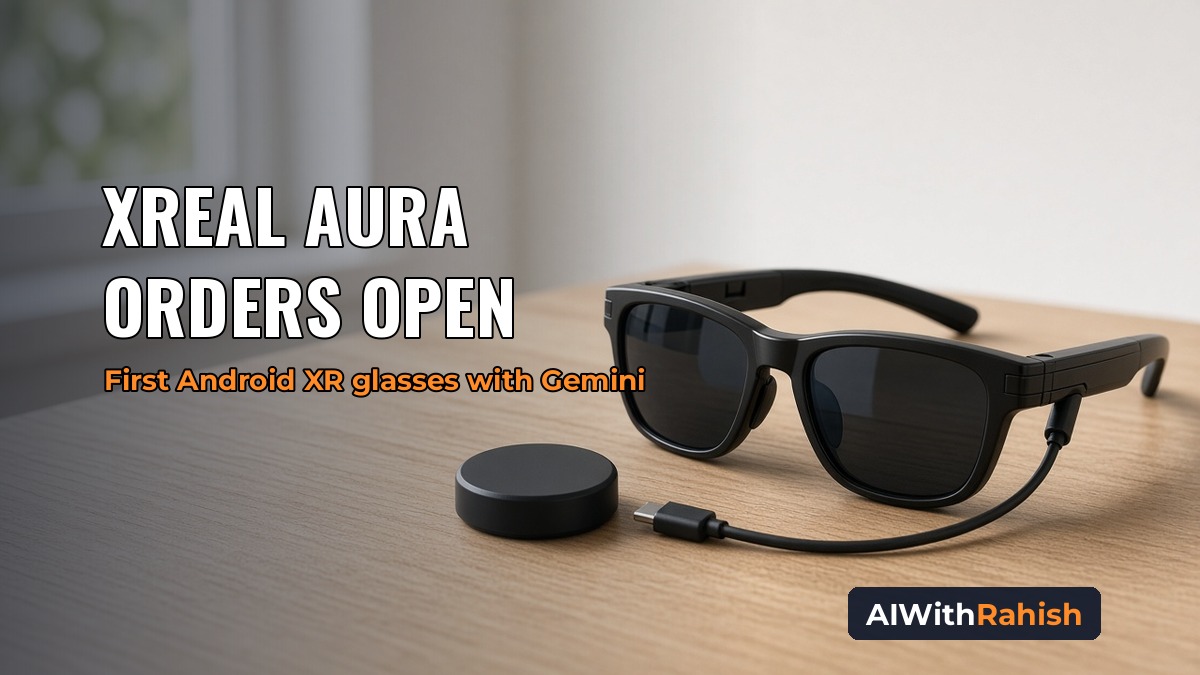
At the Android Developer Summit on Oct. 28, 2026, Google and XREAL officially launched XREAL AURA, which Google describes as the first wired XR glasses powered by Android XR. Shahram Izadi, VP and GM of XR at Google, framed AURA as a new way to work, watch, and play on a private canvas while staying aware of the room around you—with Gemini built into the platform to understand what you see on your screens and in the real world. Orders opened the same day in the U.S., Canada, and Korea, with Japan following on Nov. 2, and shipments are slated to begin in mid-November.
Key facts
| Item | Detail |
|---|---|
| Launch | Oct. 28, 2026 — Android Developer Summit; Google + XREAL |
| Platform | Android XR on a wired glasses + compute Puck design; Gemini integrated |
| Display | Transparent lenses, 70° field of view; Sony Micro-OLED 1920×1200 per eye, up to 1050 nits, up to 120 Hz |
| Weight | Glasses Under 95 g (Google); processing and battery in the Puck |
| Price | From USD 1,099 launch pricing through end of year (Google); U.S. shop lists $1,279 regular / $1,099 sale |
| Order | 18+; xreal.com/aura, Best Buy (U.S.); mid-November shipping |
What Google and XREAL launched
Google's Oct. 28 post positions AURA as a break from sealed VR headsets: transparent lenses let you see your surroundings while spatial and 2D apps sit in your field of view, with a 70-degree field of view to fit multiple windows at once. Android XR brings Gemini and apps from Google Play—including more than 150 apps made for XR, per Google—to a form factor XREAL has been teasing for months under the Project Aura name.
The same day, XREAL opened product and shop pages with full specs; Google points businesses to the Android Enterprise blog for deployment options.
How it works: glasses plus Puck
AURA uses a split-compute design. Lightweight glasses connect by cable to a portable Puck that runs Android XR, handles processing and connectivity, and holds the battery plus a touchpad—so the glasses stay under 95 grams, with heavy lifting on Qualcomm's Snapdragon Reality Elite platform debuting on AURA, per Google.
XREAL integrates its in-frame XREAL X1S Spatial Coprocessor for low-latency tracking and AI visual processing, alongside world-facing cameras for 6DoF anchoring and hand tracking. You can navigate with gestures, voice, the Puck touchpad, or Bluetooth keyboards, mice, and game controllers. The box includes glasses, Puck, carrying case, USB-C cable, nose pads, and a prescription lens frame, per XREAL's product FAQ.
For productivity, Google highlights multi-window layouts and Wired Mirroring: a USB-C laptop with video output appears as a resizable window beside Android XR apps with no extra software.
What Gemini does on AURA
Google says Gemini on Android XR understands what you're seeing and doing, both in the real world and on your screens, so you can ask for help across apps in natural conversation. Starting Oct. 28, Gemini can go beyond voice answers: share your view and Gemini can highlight what to focus on in the room or on screen—useful for maps, troubleshooting, or tidying virtual windows.
XREAL's product copy matches: voice control, answers about what you are looking at, and help inside any app.
Specs and hardware highlights
Official specs align on Sony Micro-OLED at 1920×1200 per eye, up to 1050 nits and 120 Hz, 70° FOV, five-level electrochromic dimming, and Bose-tuned audio. The Puck lists 12 GB + 256 GB or 16 GB + 512 GB tiers with a 4,455 mAh battery on XREAL's spec sheet.
9to5Google reports SKUs at $1,279 ($1,099 through Dec. 2026) and $1,499 ($1,299), plus a GameSir controller with a Gemini button—beyond Google's launch post.
Price, availability, and shipping
Google lists launch pricing starting at USD 1,099 through the end of the year, with orders at xreal.com/aura and BestBuy.com in the U.S., plus Canada and Korea on Oct. 28 and Japan from Nov. 2. Purchasers must be 18+; shipments begin in mid-November. The U.S. shop shows $1,099 against $1,279 regular. Android Authority reports select Google Store retail in 2027.
Why it matters
Analysis. AURA is Google's first retail-ready proof that Android XR and Gemini belong on your face, not only on a phone. Wired compute is a compromise—you carry a Puck—but it trades bulk on your head for the thermal and battery headroom Qualcomm's Reality Elite needs to run Play Store apps, hand tracking, and multimodal Gemini without turning glasses into a half-kilogram headset.
The same launch week also saw heavy assistant-hardware news elsewhere—compare Amazon Unveils Echo Time and Four More Alexa+ Devices for how platform owners are racing to put AI within arm's reach in the home while Google tests Gemini on your face.
For developers, 150+ XR apps and Play Store catalog give Android a spatial distribution story. Enterprise deployment options could matter if deskless teams adopt private multi-monitor setups.
The launch sits beside Google's frontier-model week—see Google Unveils Gemini 4 Carbon for Cyber Defenders First—with Gemini pushed into both cloud security and consumer spatial OS surfaces.
What to watch
Mid-November shipments will test comfort, heat, and Gemini view-sharing in bright rooms. Track Wired Mirroring with travel laptops, prescription and IPD fit, and whether 9to5Google's reported 2027 Google Store rollout lands on schedule.
Sources
- Google Blog: XREAL AURA: Wired XR glasses to watch, work, and play — Oct. 28, 2026
- XREAL: XREAL AURA | It Feels Like Tomorrow
- XREAL Shop: XREAL AURA
- 9to5Google: XREAL Aura is coming in November with a special $200-off launch discount — Oct. 28, 2026
- Android Authority: XREAL Aura brings Android XR and Gemini to your eyes, but it'll cost you — Oct. 28, 2026