LLMs
Anthropic Launches Claude Haiku 5.5: 75% Cheaper, 1M Context and Its Fastest Small Model Yet
Oct 8, 2026·6 min read·By Rahish Saifi
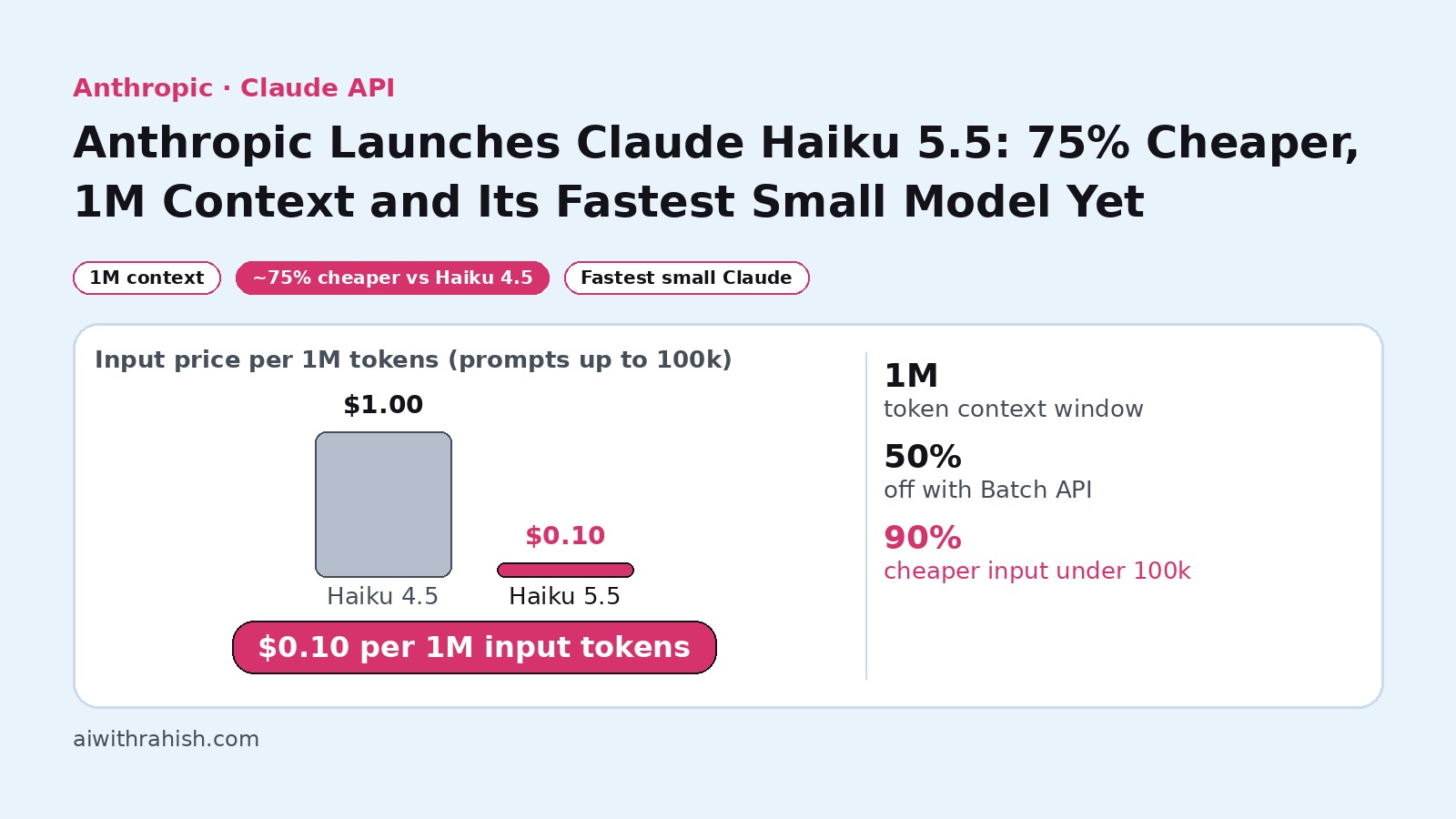
On October 7, 2026, Anthropic released Claude Haiku 5.5, calling it the cheapest, fastest, and most capable small model we’ve ever released. For teams that route millions of cheap calls through a “small” Claude—summaries, classification, query generation, context compaction—the update is less about winning every benchmark and more about making those workloads affordable at a 1 million-token context window without giving up responsiveness.
The same announcement bundles two developer-facing extras: Sonnet 5.5 cache-read pricing drops, and monthly API credits for Max and Team subscribers. If you are on Haiku 4.5 today, the migration story is mostly about model IDs, token accounting, and knowing when to keep Sonnet or Opus on the critical path.
What’s new
Haiku 5.5 is aimed at high-volume, cost-sensitive work: summaries, compactions, database queries, and classification. Anthropic positions it alongside Opus 5.5 and Sonnet 5.5 as a subagent on coding tasks—fast passes for narrow steps while larger models handle complex agentic coding.
On latency, Anthropic says Haiku 5.5 is its fastest model to date at standard speed (Opus in Fast Mode is still quicker). That makes it a natural fit for live customer support and browser use, where turnaround time matters as much as raw capability.
Technical highlights from the model overview and what’s new docs:
- Model ID:
claude-haiku-5-5(Amazon Bedrock:anthropic.claude-haiku-5-5). - Context: 1M input tokens and 128K max output (Haiku 4.5 was 200K / 64K). Message Batches API supports up to 300K output with beta header
output-300k-2026-03-24. - Modalities: text and images in, text out; knowledge cutoff June 2026.
- Behavior defaults: adaptive thinking on by default; first Haiku-class model with an adjustable effort setting (default
medium). - Tokenizer: newer tokenizer—same text counts as roughly 30% more tokens than on Haiku 4.5, which matters when you compare bills.
- Sampling: non-default
temperature,top_p, ortop_kvalues return a 400 error. - Lifecycle: retirement not sooner than October 7, 2027.
Availability is immediate on the Claude API and Claude Platform, plus Amazon Bedrock, Google Cloud, Microsoft Foundry (Azure), and Claude Platform on AWS.
Pricing and what changed in your bill
Anthropic’s headline is that Haiku 5.5 costs on average ~75% less to run than Haiku 4.5. The list price is 90% lower for requests up to 100,000 tokens and 50% lower above 100k; Anthropic notes that ~90% of Haiku 4.5 requests were under 100k. The blended 75% figure accounts for the new tokenizer using slightly more tokens per task.
| Rate (per 1M tokens) | Haiku 5.5 (≤100k prompt) | Haiku 5.5 (>100k prompt) | Haiku 4.5 | Sonnet 5.5 |
|---|---|---|---|---|
| Input | $0.10 | $0.50 | $1.00 | $2.00 |
| Output | $0.50 | $2.50 | $5.00 | $10.00 |
| Cache reads | $0.01 | $0.05 | $0.10 | $0.10 (was $0.20) |
| 5-min cache writes | $0.125 | $0.625 | $1.25 | $2.50 |
| 1-hour cache writes | $0.20 | $1.00 | $2.00 | $4.00 |
Batch API pricing is 50% off standard rates. Alongside Haiku, Anthropic halved Sonnet 5.5 cache reads from $0.20 to $0.10 per 1M tokens—roughly 20% cheaper on most agentic tasks for Sonnet users who lean on prompt caching.
Subscriber API credits (rolling out the week of launch): Max 5× gets $100/month, Max 20× gets $200/month, and Team plans get up to $500 pooled, usable on any model. Python and TypeScript SDKs also add computer use and browser use support in beta.
Benchmarks (and how to read them)
Anthropic’s published scores compare Haiku 5.5 to Haiku 4.5, with Sonnet 5.5 and GPT-6 Luna shown where noted. Treat these as vendor-reported signals, not independent audits—but the direction is clear: Haiku 5.5 is a much stronger small model than 4.5 on knowledge work and tool-style tasks, while Sonnet and Opus still lead on hard agentic coding.
| Benchmark | Haiku 5.5 | Haiku 4.5 | Reference |
|---|---|---|---|
| GDPval-AA v2.1 (knowledge work) | 1620 | 735 | Sonnet 5.5: 1840; GPT-6 Luna: 1437 |
| AA-Briefcase v1.1 | 1578 | 614 | — |
| OSWorld 2.1 (offline subset) | 72.4% | 15.7% | Sonnet 83.9%; GPT-6 Luna 48.9% |
| Humanity’s Last Exam | 45.9% / 57.4% (tools) | 10.2% / 18.7% | — |
| Terminal-Bench 4.0 | 39.2% | 0.0% | Sonnet 70.6% |
| FrontierCode 1.1 | 46.4% | — | GPT-6 Luna 42.4% |
| Chartography | 46.4% | 6.4% | — |
Anthropic’s own guidance: Sonnet 5.5 and Opus 5.5 remain better for complex agentic coding; Haiku 5.5 shines on narrowly scoped jobs like compaction, summarization, and subagent work.
Early customer results Anthropic published include Asana (Aaron Vinh, Staff Software Engineer) reporting over a 30% reduction in latency for task completions and up to 2.5× faster inference per agent turn; HubSpot (Ze’ev Klapow, Distinguished Software Engineer) saying Haiku 5.5 got the best score we’ve seen on this suite yet, at 92.8% averaged over three runs; and Box (Yashodha Bhavnani, VP of AI Products) noting Haiku 5.5 scored 11 points higher than Haiku 4.5 at about half the latency.
Who should use it—and migration notes
Good fits: pipelines that fan out many small calls; RAG pre-processing and post-processing; support bots that need snappy replies; browser or tool loops where Haiku can act as a fast subagent; batch summarization over long documents now that 1M context is in play.
Stay on Sonnet or Opus when: you need reliable multi-step coding agents, hard reasoning chains, or maximum scores on Terminal-Bench-style tasks—Haiku 5.5’s jump is real, but Anthropic still routes “hard agentic coding” to the larger models.
Before you flip the model string:
- Swap to
claude-haiku-5-5(and the Bedrock ID if you deploy on AWS). - Re-estimate token usage: the ~30% tokenizer delta can eat part of the headline savings if you budgeted on Haiku 4.5 token counts.
- Remove custom
temperature/top_p/top_kunless you are fine with defaults—other values error. - Review effort settings (new on Haiku) and default adaptive thinking if latency or cost spikes on simple prompts.
- If you use prompt caching, reprice with the new cache read/write tiers; Sonnet users should replan after the cache-read cut.
Safety
Anthropic reports major improvements on alignment evaluations versus Haiku 4.5. Cyber safeguards are more restrictive than Haiku 4.5’s but less restrictive than other recent models; the model blocks penetration testing. Details are in the Claude Haiku 5.5 System Card.
The bigger picture
- Small models are no longer “dumb and cheap.” Haiku 5.5 pairs a flagship-scale context window with sub-dollar input pricing for typical prompts—competition for every “route to the small model” layer in production stacks.
- Token math matters again. When vendors ship new tokenizers alongside price cuts, your dashboards need per-model token baselines, not assumptions from the last generation.
- Caching is a product strategy. Cutting Sonnet cache reads the same week as launching a cache-friendly Haiku tier signals that Anthropic expects agentic apps to lean on cached system prompts and tool schemas.
- Subagent architectures get cheaper. If Opus or Sonnet orchestrates and Haiku executes bounded steps, Haiku 5.5’s speed and price make that pattern easier to justify at scale.
The bottom line
Claude Haiku 5.5 is Anthropic’s bet that most production traffic does not need a frontier model on every call. With 1M context, a large step up in reported benchmarks over Haiku 4.5, and list prices starting at $0.10 per million input tokens for standard prompts, it is built to own the long tail of AI workloads—while Sonnet and Opus keep the crown for the hardest coding agents. Migrate deliberately: update IDs, retokenize your estimates, and keep the heavy lifting on the models that still win Terminal-Bench.