LLMs
Google’s EmbeddingGemma 2 Is a 740M Open Model That Brings Multimodal Search On-Device
Oct 7, 2026·4 min read·By Rahish Saifi
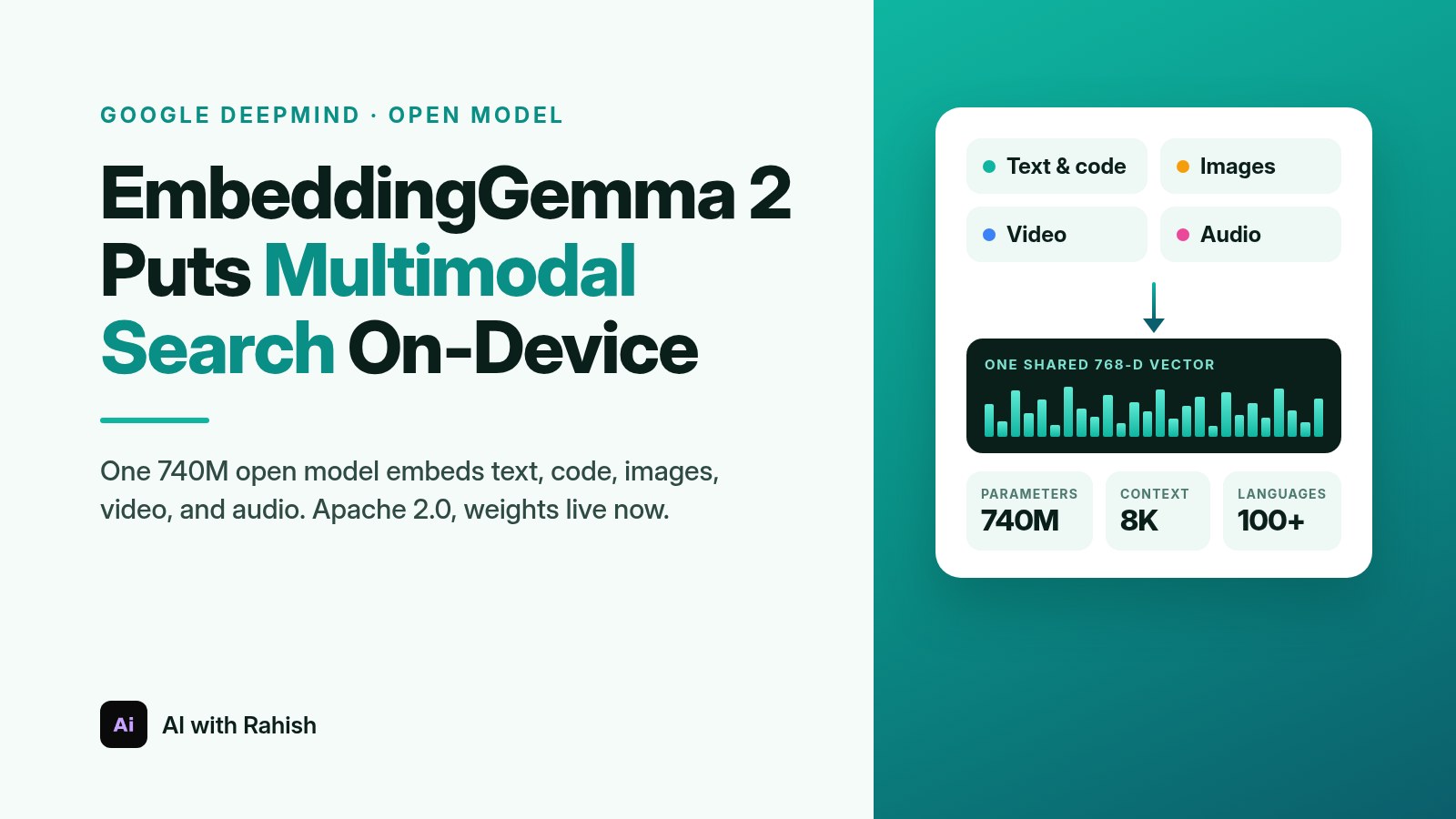
Google has released EmbeddingGemma 2, and it is a big step for anyone building search or retrieval that runs on a phone or laptop. Announced on October 6, 2026, the new open model from Google DeepMind turns text, code, images, video, and audio into vectors in one shared space, and it does it in just 740 million parameters.
Google CEO Sundar Pichai called it the company’s “first open, natively multimodal embedding model.” The weights are available now on Hugging Face and Kaggle under the commercially permissive Apache 2.0 license.
What EmbeddingGemma 2 actually does
An embedding model turns content into a list of numbers, called a vector, so that similar things end up close together. That is the engine behind semantic search, recommendations, and the retrieval step in RAG (retrieval-augmented generation) systems.
The first EmbeddingGemma, released last year, handled text only. Google says it passed 20 million downloads. Version 2 keeps that text quality and adds the other modalities, so a single model can, in Google’s examples, find a video clip from a voice memo or search hours of audio with a typed query.
The key specs
- Size: 740M parameters in total, built on the Gemma 4 architecture.
- Modular design: a 270M text backbone (a 130M transformer plus a 140M embedder) with optional vision (170M) and audio (300M) encoders. Text-only apps can skip the rest.
- One vector space: every input lands in the same 768-dimensional space, so a text query can match an image, a clip, or a recording.
- Smaller vectors on demand: using Matryoshka Representation Learning, vectors can be cut from 768 to 512, 256, or 128 dimensions, for up to 6x less storage in a local vector database.
- Longer context: an 8K-token window, four times the original. Google says that covers up to 5.5 minutes of audio, 29 images, or 58 video frames.
- Languages: the model card says it understands more than 100 languages.
Built to run on a phone
The headline claim is efficiency. Google says that with quantization on a Pixel 11 Pro, the text-only weights need about 191MB of active RAM, and the full multimodal model needs about 567MB.
It is also designed to sit next to Gemma 4. The two models share a text tokenizer and an audio encoder, so developers can run both in one on-device pipeline with a smaller combined memory footprint. EmbeddingGemma 2 finds the right files, and Gemma 4 reasons over them, all without sending data to a server.
How it scores
These numbers come from Google’s launch post and model card and have not yet been independently reproduced:
- Code search: MTEB Code rose from 68.76 to 78.68, a 9.92-point jump over the first version. Google pitches this for local codebase indexing and retrieval for coding agents.
- Images and documents: 57.28 Hit@1 on MMEB v2 Image and 67.84 NDCG@5 on MMEB v2 VisDoc.
- Video: 50.67 Hit@1 on MMEB v2 Video.
- Audio: 69.54 MRR@10 on MSEB retrieval and 49.39 on MAEB.
Google says these are leading scores among multimodal embedders under 1B parameters, and that the model outperforms some specialist models more than twice its size.
Why it matters for AI builders
- Private search by default. Embeddings can be generated entirely on the device, so photos, voice notes, and documents never have to leave it. That matters for health, legal, and enterprise apps.
- One model instead of several. Teams that stitch together separate text, image, and audio embedders can test whether one shared space is good enough, which simplifies indexing and cuts memory.
- Better retrieval for coding agents. The large code gain makes it a cheap local option for semantic code search.
- A permissive license. Apache 2.0 means commercial use without a custom license to negotiate.
Where to get it
The weights are on Hugging Face and Kaggle, with on-device builds in the LiteRT Community on Hugging Face. Google says availability in Model Garden on its Gemini Enterprise Agent Platform is coming soon.
Google lists support in transformers, sentence-transformers, MLX, vLLM, llama.cpp, SGLang, Ollama, and LM Studio, plus Qdrant for storing vectors and Unsloth guidance for fine-tuning. Browser apps can use transformers.js or WebGPU, and Android developers can use MediaPipe or LiteRT.
To see it working, Google points to demos in the Google AI Edge Gallery app, including Instant Media Search and Video Moments Finder, and the Google AI Edge Foresight app for on-device RAG.
The bottom line
Multimodal embeddings have mostly lived in cloud APIs. EmbeddingGemma 2 makes a credible case that phones and laptops can do this work locally, under a license developers can actually ship with. The next test is independent benchmarks and real apps built on it.