Deep Learning
Google Launches Playground, a Free AI Tool That Turns Text Prompts Into Playable Games
Oct 7, 2026·4 min read·By Rahish Saifi
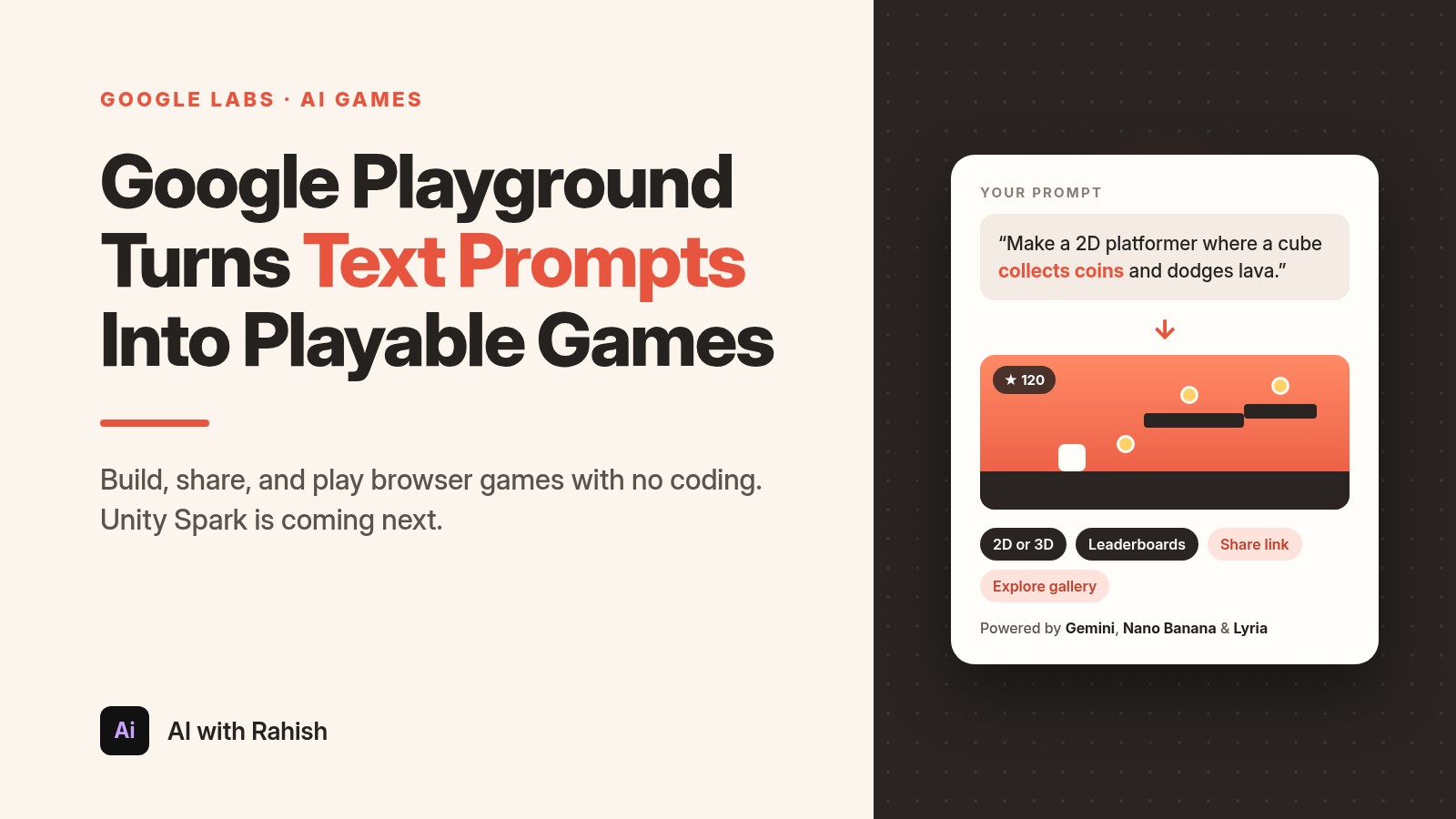
Google wants anyone to be able to make a video game by describing it. On October 7, 2026, the company launched Playground, an “experimental gaming platform” where you type what you want to build and get a browser game you can play, share, and keep tweaking. No coding is required.
Playground is live today at playground.google for users in the US who are 18 or older. Google also used the launch to preview Unity Spark, a more advanced, Unity-powered creation tool that will plug into Playground later.
What Playground does
- Prompt-to-game creation. A chat interface lets you “direct the game just by typing what you want to build.” You can start from a blank canvas, remix starter prompts, or use guided support, then test the game right away.
- Edit by asking. Google says you can tweak the physics, rewrite the rules, customize the characters, or overhaul the environment with more prompts.
- 2D or 3D, solo or multiplayer. According to 9to5Google, you pick a 2D or 3D game and whether it is single-player or multiplayer. Google says multiplayer and in-game leaderboards work in “select genres.”
- Runs in the browser. Games play on a phone or a laptop, with nothing to install.
The AI models behind it
Playground is a Google Labs experiment. A Google spokesperson told The Verge it runs on “Google’s existing foundation models (Gemini, Nano Banana, and Lyria) paired with a custom harness refined through our own internally built games and evaluations.”
Gemini is Google’s main AI model family, Nano Banana is its image model, and Lyria is its music model. Google has not detailed how each one is used inside Playground. The interesting part is the harness: Google is not shipping a new model here. It is packaging models it already has into a product built for one task, a common way AI labs now turn models into consumer apps.
Sharing, leaderboards, and safety
- Three ways to publish. Keep a game private, send a shareable link, or publish it to the Playground Explore gallery for the wider community.
- Play Games profiles. With a Play Games profile you can claim a custom handle, like games, compete on leaderboards, and follow creators.
- Ranking. Google says the gallery uses player ratings and play activity to spotlight games that are “fresh, creative, and fun.”
- Moderation. Every published game goes through safety screening aligned with Google’s Community Guidelines, plus user reporting.
Is Google Playground free?
Yes, to start. The Verge reports that Playground is free to use, and Google One subscribers get higher weekly token limits depending on their plan. Google’s own post describes this as “tiered creation access” based on Google One membership. Google has not announced when Playground will expand beyond the US.
Unity Spark: the pro tier that comes next
For creators who outgrow simple prompts, Google says Playground will “soon” integrate Unity Spark, which brings professional-level mechanics, high-fidelity 3D, and the Unity runtime. Games built with Spark will be playable on Playground.
- Status: Spark is in testing. The Verge reports a closed beta later this year, with a waitlist open from today.
- Collaboration: The Verge says Spark lets people build games together at the same time.
- Assets: Unity CEO Matthew Bromberg says Spark connects directly to the Unity Asset Store.
Bromberg also pushed back on low-effort AI games: “This isn’t about ‘one-shotting,’” he wrote, adding that Spark is about being able to “create real, unique interactive experiences.”
Why it matters
- AI game-making is now a platform race. The Verge notes that Meta recently announced AI game creation for Horizon, and Roblox is testing an AI “Build” feature in public alpha. Google now has a creation tool, a gallery, and a pro tier through Unity.
- Distribution is built in. Sharing links, a public gallery, and Play Games profiles mean a prompt-made game can find players without a store listing.
- The quality debate is not settled. As Game Developer points out, many game developers remain skeptical of generative AI, and Steam requires developers to disclose AI use on store pages.
The bottom line
Playground is Google’s clearest bet yet that game creation can work like a chat. It is free to try in the US, it is built on Gemini, Nano Banana, and Lyria rather than a new model, and Unity Spark gives it a path to more serious games. The real test is whether the Explore gallery fills with games people actually want to play.