Deep Learning
Google Opens SynthID Detector to Everyone: Check Photos, Video and Audio for AI Watermarks
Oct 8, 2026·6 min read·By Rahish Saifi
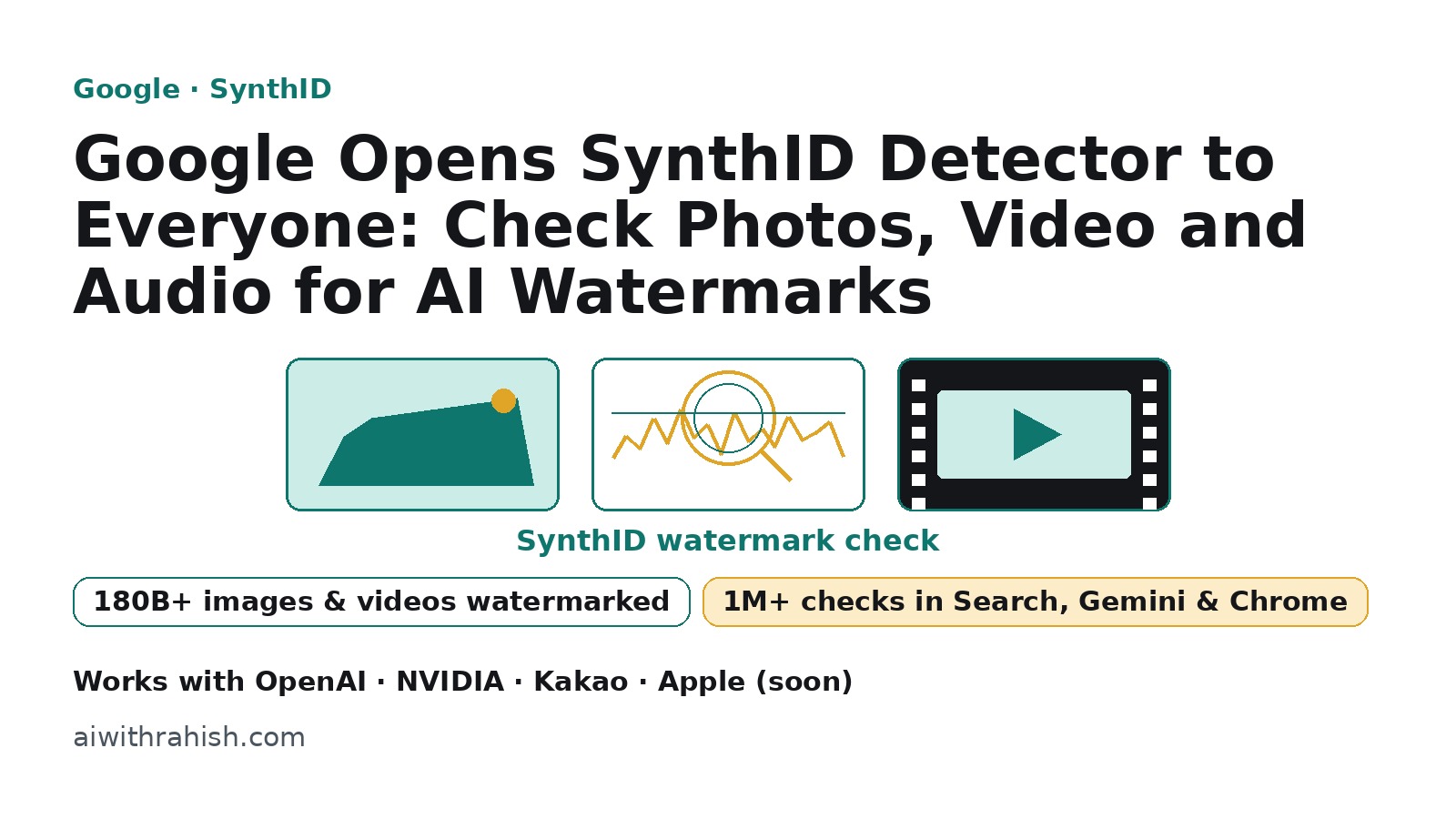
On Wednesday, October 7, 2026, Google expanded SynthID Detector access to everyone—globally, in English. Pushmeet Kohli, VP of Science and Strategic Initiatives at Google DeepMind, framed the move in plain terms: “As AI tools become better and easier to use, having clear context about the content you encounter online helps you make informed decisions about what to trust.”
That is the shift for readers in India and elsewhere who have been forwarding suspicious images on WhatsApp or wondering whether a campaign clip is synthetic: Google is no longer limiting the checker to media professionals. The public portal at synthid.com joins verification already baked into Search, the Gemini app, and Chrome, which Google says now regularly handle over 1 million requests daily.
Key facts at a glance
- What launched: Public SynthID Detector—upload an image, video, or audio file to see whether it carries a SynthID watermark from Google or participating partners.
- When: Global access in English starting October 7, 2026 (announced 7:30 PM IST). Google first previewed an early detector for professionals in 2025; an early version was introduced at I/O in May 2025, per secondary reporting.
- Scale behind it: Google reports over 180 billion images and videos watermarked to date, plus 240,000 years of audio content.
- Partners on the label: Detection covers media from Google and partners including OpenAI, NVIDIA, and Kakao, with Apple support coming soon.
- Critical limit: The synthid.com detector page states this is not a general AI detector—it only finds media that still carries SynthID watermarks from adopters of the standard.
What changed
SynthID itself is not new. Google launched the imperceptible watermarking technology in 2023, embedding signals across images, video, and audio so downstream systems can verify provenance without visible stamps. What changed on October 7 is who can run the check.
Last year, Google introduced an early SynthID Detector aimed at journalists and media professionals. After testing and feedback, Google DeepMind’s SynthID page says the company is “expanding access to everyone.” Kohli’s post puts it directly: “Now, we're expanding access to everyone – with the tool available globally in English starting today.”
The detector sits alongside a broader verification stack. Google’s Keyword post notes that built-in checks in Search, Gemini, and Chrome “now regularly handle over 1 million requests daily,” suggesting consumers were already hitting verification flows before the standalone upload site opened wide.
How to use SynthID Detector (step by step)
If you have a file and want a SynthID-specific answer—not a guess about “AI-ness” in general—this is the workflow:
- Open synthid.com in a browser.
- Sign in. The Next Web, citing Engadget, reports the tool is free but requires signing in with a Google, OpenAI, or Apple account.
- Upload your file. TechCrunch lists supported formats: images (JPG, JPEG, PNG, BMP, WEBP, AVIF, HEIC, HEIF, TIFF, TIF, GIF), video (MP4, MOV, WEBM), and audio (WAV, MP3, OGG, FLAC, AAC, M4A).
- Read the result. According to The Next Web, Google’s sample result says the media “was made or edited with Google AI.” Reporting highlights an important nuance: a positive hit does not always mean the entire file was generated from scratch—it may have been edited with a participating AI tool.
For quick sanity checks on forwards—election graphics, scam voice notes, viral clips—the upload path is simpler than asking a chatbot to opine. Just remember you are testing for SynthID presence, not for every possible generative model.
What SynthID can detect—and what it cannot
Honesty matters here. The synthid.com detector page is explicit: “This is not a general AI detector.” The portal only identifies media carrying SynthID watermarks from companies that adopted SynthID.
That means several real-world gaps:
- No watermark, no signal. Content from providers that never embedded SynthID—or that used a different standard—will not be flagged, even if it is fully synthetic.
- Watermarks can be stripped. The synthid.com FAQ notes the watermark is not infallible: if someone tries many transformations, they may find one that does not get detected. Secondary coverage also warns that watermarks may be removed in some cases, which would yield a false “clean” read.
- Compression and editing. synthid.com recommends uploading the highest-quality file possible; heavy compression and editing can degrade the watermark signal and affect detection.
- Rare false positives. In very rare cases SynthID can also falsely trigger on non-watermarked content, per the synthid.com FAQ.
- Partner coverage is partial. Microsoft and Meta maintain their own watermarking approaches, per TechCrunch—so a viral Meta-generated image might not appear in SynthID results.
- Editing vs full generation. Language like “made or edited” means a Photoshop-style touch-up through a Google AI surface could trigger a match without implying the whole scene is fake.
Treat SynthID as one layer in a trust stack: corroborate with source, metadata when available, and outlet reputation—not as a courtroom-grade universal test.
Who watermarks with SynthID
Google’s October 7 announcement says the new detector can check whether files were made with AI from Google or partners, including OpenAI, NVIDIA, Kakao, and soon, Apple. On Google’s side, TechCrunch ties watermarking to models and surfaces such as Nano Banana, Veo, and Lyria, plus tools like Gemini, Flow, ProducerAI, and Vids.
The partner list matters for India’s builder ecosystem too: as more global tools adopt a shared verification label, newsrooms and individual users get one place to check whether an asset carries a watermark from a participating generator. synthid.com is a manual, one-file-at-a-time portal, not a public API.
Why it matters for deepfakes, scams, and forwards
India’s information diet runs heavily on WhatsApp forwards, short video, and audio clips. Election seasons and fraud waves both reward synthetic media that looks authoritative. Google is not claiming SynthID solves misinformation outright; the bet is narrower—give ordinary people a free, labeled check when a file might come from a participating AI pipeline.
Kohli’s quote captures the design goal: context, not hype. When verification in Search, Gemini, and Chrome already exceeds a million checks a day, opening the upload portal extends the same infrastructure to files you already have on disk—think a relative’s forwarded “bank notice” JPEG or a clipped campaign video.
For creators, the flip side is transparency: if you publish client work generated with watermarked tools, recipients may increasingly run those assets through SynthID. Disclosure and workflow hygiene become part of the product story, not an afterthought.
What to watch next
Apple joining the partner set is the near-term headline Google itself flags as “soon.” Wider language support beyond English will determine how useful the portal is for non-English-first users in South Asia.
Watch also how rivals’ standards interoperate—or do not. If Microsoft and Meta keep parallel watermark schemes, consumers will need multiple checkers or unified readers in browsers and messaging apps. Google’s expansion is a step toward a labeled internet, not a fully labeled one.
If you build multimodal products, pair this news with tooling trends: Google’s Nano Banana 2.1 price cuts and EmbeddingGemma 2 show how fast image and embedding stacks are moving—verification is catching up on the consumption side.
Sources
- Google Keyword: Google expands SynthID Detector for AI content (Pushmeet Kohli, Oct 7, 2026)
- Google DeepMind: SynthID
- SynthID Detector (synthid.com) and FAQ
- TechCrunch: Google’s new SynthID website can identify AI-generated media (Ivan Mehta, Oct 7, 2026)
- The Next Web: Google SynthID Detector public AI content checker (Oct 7, 2026)
- Engadget: Google’s AI detection website is now available (Karissa Bell, Oct 7, 2026)