LLMs
OpenAI Releases 722 Math Manuscripts From an Unreleased Internal AI Model
Oct 7, 2026·4 min read·By Rahish Saifi
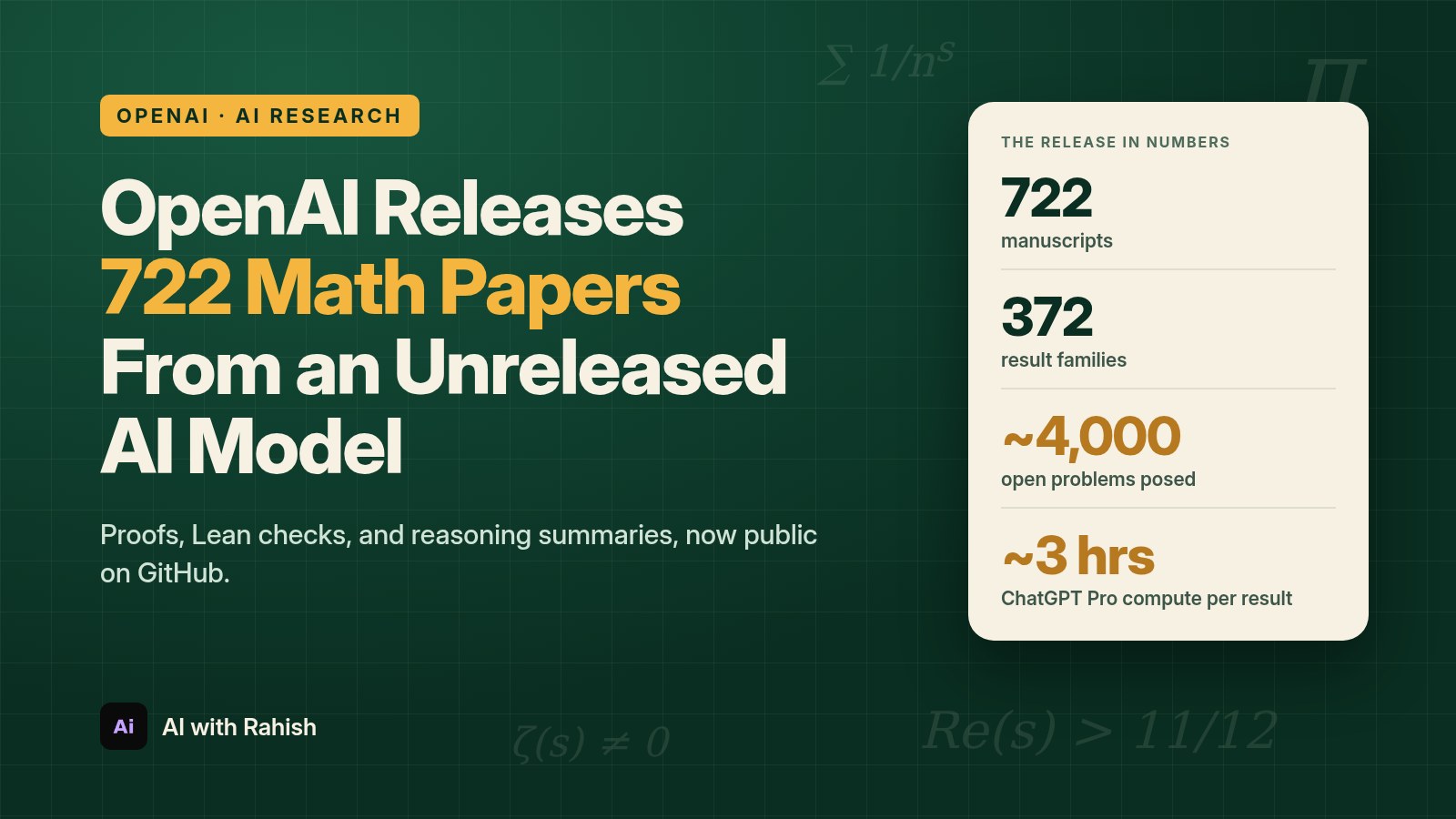
OpenAI has put 722 mathematical manuscripts on GitHub, all produced by an internal frontier model the public cannot use yet. The papers are grouped into 372 result families, and OpenAI says each one either solves an open problem or makes real progress on it.
The release went out on October 6, 2026 as a blog post, “Sharing AI progress in mathematics,” plus a new repository at github.com/openai/math. It is an unusually large release of AI-written math research, and it moves the hard question from “can AI do this?” to “who is going to check all of it?”
What OpenAI released
- 722 manuscripts in 372 families. A family groups related papers: a main result, companion arguments, consequences, or alternative proofs. Each family is tagged by math discipline.
- Lean formal proofs for many results. Lean is a proof checker that verifies every step by machine. OpenAI says many, but not all, manuscripts are formalized, and it will add more over time.
- 10 reasoning summaries. Abridged write-ups of how the model reached results such as the irrationality exponent of π, the Mahler conjectures, Kaplansky’s direct-finiteness conjecture in characteristic two, and the isomorphism of free group factors.
- Process details. Compute estimates, statistics on how many problems were attempted, an overview PDF, and citation and revision rules for each paper.
How the results were made
OpenAI says its existing math benchmarks had saturated, so it began testing models on real open research problems instead. Over the evaluation, the unreleased model was given about 4,000 problems. After grouping the output and applying a significance bar, 372 families made the cut.
Most results came from the same fixed procedure, using on average about three hours of ChatGPT Pro thinking compute per result. OpenAI lists two exceptions: work on a zero-free region for the Riemann zeta function and a proof of the Hodge conjecture for CM abelian varieties. It also says the write-up of the Re(s) > 11/12 zero-free region was edited by humans for readability.
The caveats OpenAI spells out
- Not everything is checked. OpenAI’s own readme says “some of the unformalized results could have issues” and promises quick fixes.
- Preprints, not journal papers. The manuscripts sit in a company-owned GitHub repo. OpenAI says it is exploring community-hosted alternatives and will keep every past version public when it revises a paper.
- The model is not available. OpenAI says it is “working to responsibly release” the model, but has given no name, date, or price.
Where this model came from
In an earlier post about its new mathematics advisory group, OpenAI said it began training a new internal model on August 28, and that the model had resolved more than 100 long-standing open problems, including work it describes as resolving the Navier–Stokes Millennium Prize problem. Those are OpenAI’s claims; independent review by mathematicians is still ongoing.
OpenAI says it consulted the independent Advisory Group on Mathematics and Artificial Intelligence at the Institute for Advanced Study on how to release these results, and it plans to fund workshops, conferences, and special programs to help mathematicians understand AI-produced work.
Why it matters
- The bottleneck is now review. Hundreds of papers arrived at once. Lean proofs make some of them quick to trust, but the rest need human referees.
- A preview of the next OpenAI model. None of OpenAI’s public models wrote these papers. The model that did is a sign of where OpenAI’s reasoning models are heading.
- A new way to publish science. Versioned GitHub releases with machine-checked proofs could become a template for how AI labs share research results.
The bottom line
OpenAI’s math release is large, specific, and unusually open about its process, but it is not yet peer-reviewed knowledge. Watch the Lean-verified families first, and watch for when, and how, OpenAI lets outside researchers use the model itself.